Discussions on research, teaching and joint projects during the diplomat’s and the Honorary Consul’s visit to HTWK Leipzig on 9 March 2026
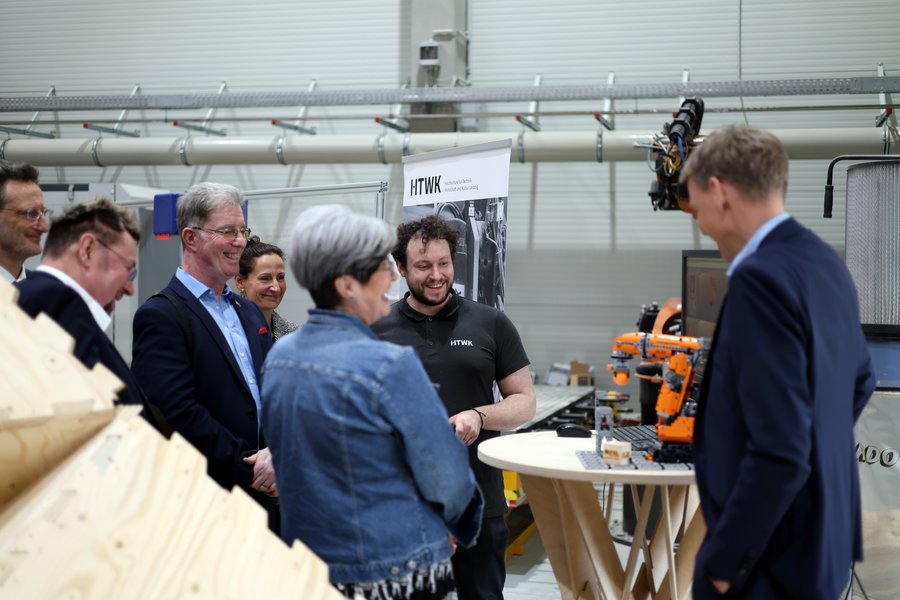
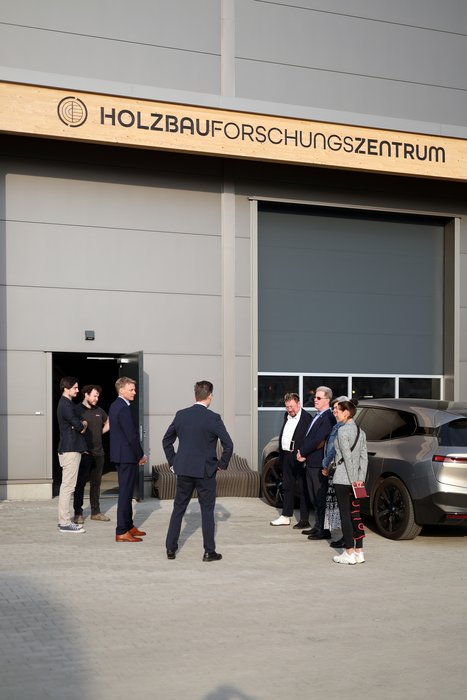
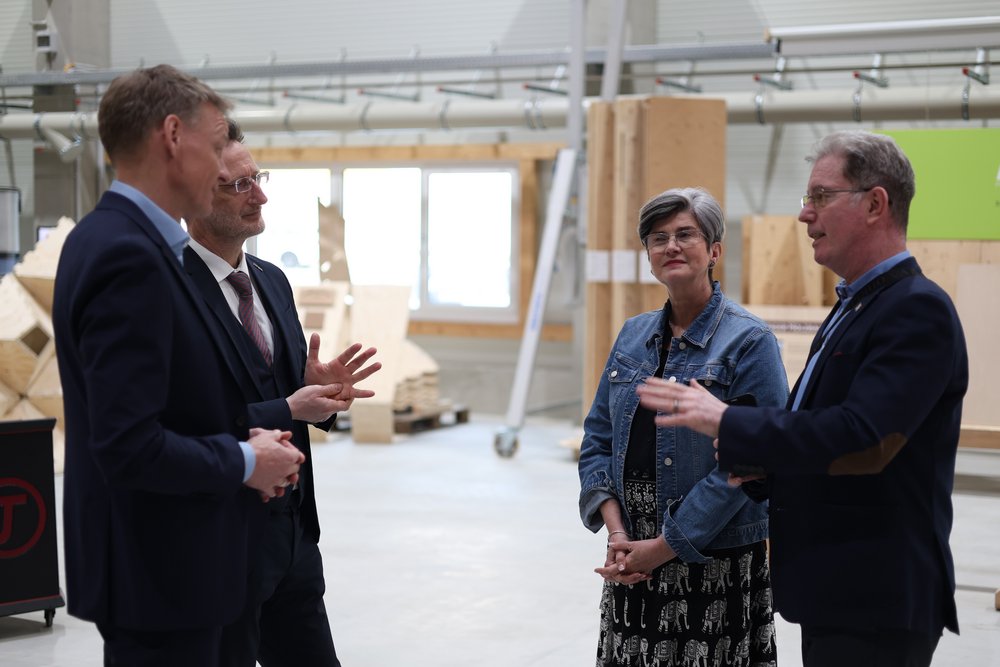
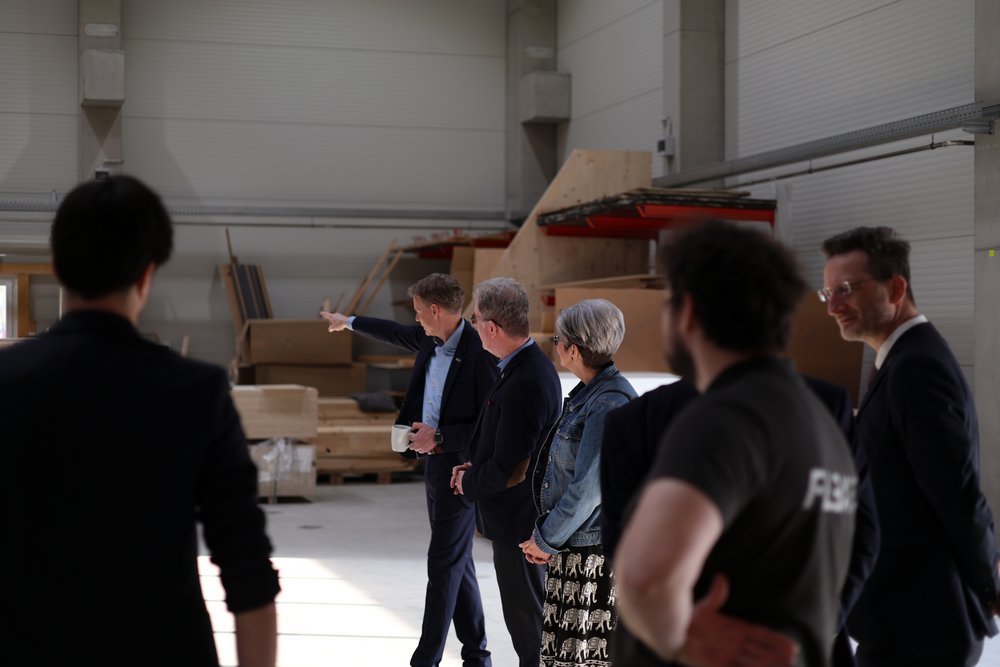
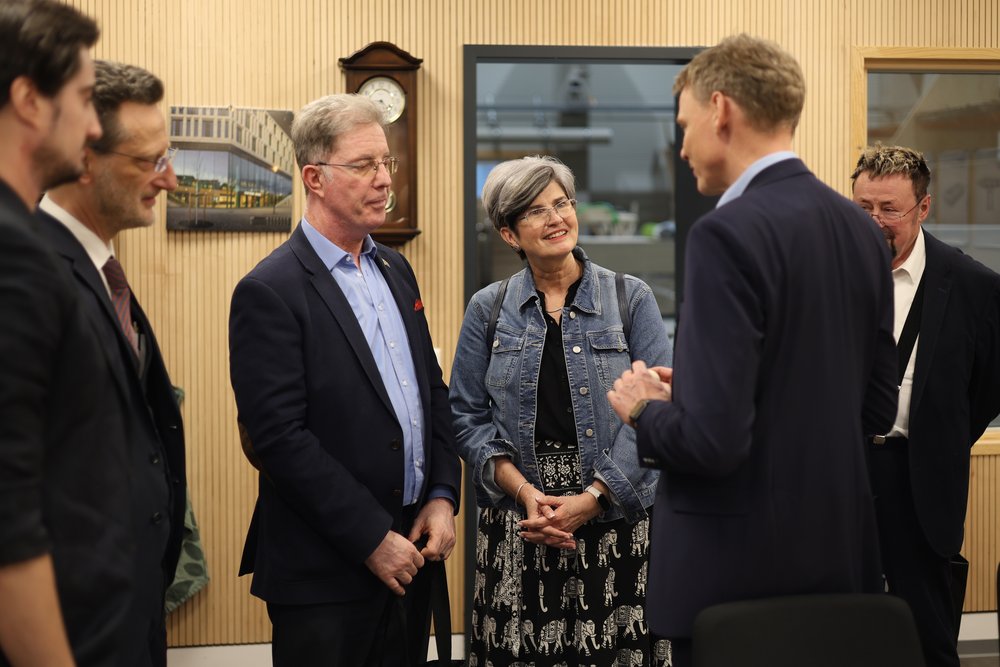
On 9 March 2026, at the Timber Construction Research Centre of HTWK Leipzig, HTWK Rector Prof. Dr.-Ing. Jean-Alexander Müller, together with the scientific director of the research hall, Prof. Dr.-Ing. Alexander Stahr, and his team from the FLEX research group, welcomed some distinguished visitors: Andries Oosthuizen, the Ambassador of the Republic of South Africa to Germany, and Prof. Dr Wolfram Scharff, Honorary Consul, came to Leipzig as part of their two-day tour of Saxony and Saxony-Anhalt to discuss the state of research into digitally-based timber construction and to explore possible future joint research projects.
In South Africa, timber construction has so far played a rather minor role. According to the Ambassador, this is set to change: modular timber construction systems could help to create high-quality housing quickly and pave the way for more sustainable architecture based on natural raw materials, particularly in urban areas such as Johannesburg.
Applied Manufacturing Research
The aim of the visit by HTWK Leipzig was therefore to showcase its scientific expertise in the field of applied manufacturing research and to share its pedagogical knowledge at the interface between digital design and manufacturing.
Following a welcome at the HolzBauForschungsZentrum, the two representatives from the Republic of South Africa toured several stations there: with a view to the imminent start of construction of the crane facility, the FLEX researchers first presented their vision for the project. Once completed, this will create a unique, large-scale research infrastructure enabling digital design models for automated manufacturing processes in timber construction to be developed and tested on a full-scale basis. The industrial robots, which will then be suspended at a height of approximately five metres, can reach almost any point in the approximately 1,000-square-metre hall via a 31-axis system, thereby enabling highly flexible manufacturing processes.
AR technology also plays a role in timber construction: using the expertise developed in the ‘OptiPaRef’ research project as an example, the FLEX researchers demonstrated the benefits of augmented reality in timber construction: by looking through AR glasses, attendees were able to experience how carpenters might work in the future. With AR, complex information relating to the manufacture of individual components can be displayed as holograms directly on the component itself. The AR glasses thus act as an assistant, projecting all the necessary information directly into the carpenters’ field of vision – exactly where it is needed. This means that craft-based production remains highly flexible, whilst becoming significantly faster and less prone to errors.
Cooperation in teaching
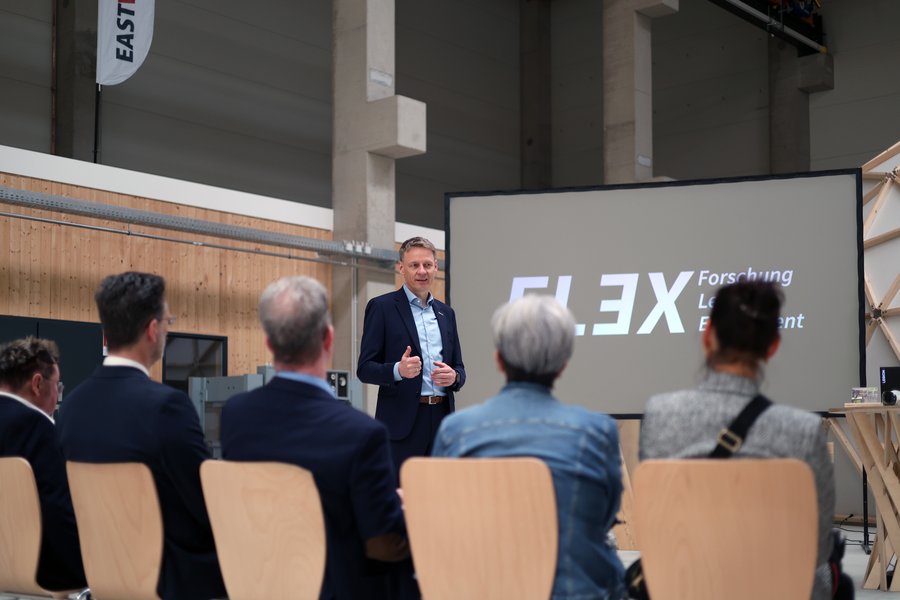
In addition to research into the future of timber construction, the ambassador showed a particular interest in the field of teaching and practical training for future architects and civil engineers. Specifically, he offered his assistance in establishing direct links with a partner university in South Africa. Furthermore, ideas were developed during the discussion on how the cooperation desired by both sides could be brought to life quickly. HTWK Professor Stahr and his team proposed that students and staff take part in a Summer School planned for August 2026, during which a so-called ‘design-build project’ is to be carried out. A proposal was also put forward for South African colleagues to take part virtually in the EASTWOOD Timber Construction Festival on 1 and 2 October 2026 at HTWK Leipzig, where they could expand their expertise.
Bridging the technological gap between South Africa and Germany
For Ambassador Oosthuizen and Honorary Consul Scharff, these were fascinating insights: Ambassador Oosthuizen highlighted the similar construction-related challenges faced by Germany and South Africa – and, at the same time, expressed great interest in participating in the research developments at the Wood Construction Research Centre at HTWK Leipzig, with a view to gradually closing the technological gap that still exists between the two countries.
Visual impressions