
The Geotechnical Engineering Seminar at HTWK Leipzig celebrated its anniversary on 1 July 2026 – A look back
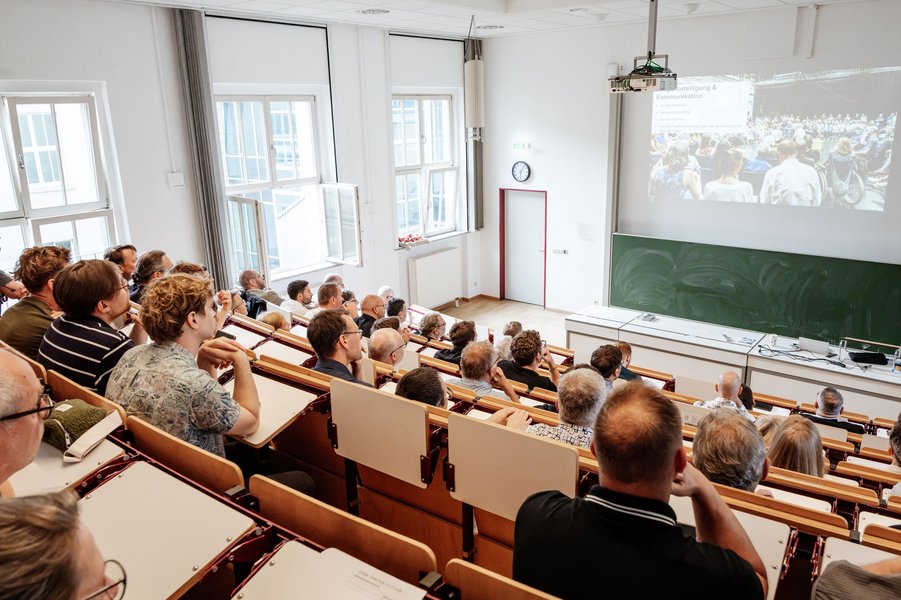
With over 100 participants, the Institute of Geotechnical Engineering at HTWK Leipzig celebrated the 100th instalment of its Geotechnical Engineering Seminar last Wednesday, 1 July 2026. Since 2016, this continuing professional development and exchange programme has provided a regular forum for experts from academia, the construction industry, business and public administration, as well as students and other interested parties, to discuss current challenges in construction practice and thereby gain fresh inspiration for research and teaching.

“Thank you to all the speakers so far, who have often agreed to take part at short notice and willingly, made no financial demands, and delivered exciting and interesting presentations – this is what keeps this geotechnical seminar going, and with this in mind I would like to offer further geotechnical seminars in the coming years,” said Professor Ralf Thiele, Head of the Institute of Geotechnical Engineering, who launched the series of events ten years ago.
Anniversary lecture on Germany’s most climate-friendly underground railway, currently under construction
As dialogue formats such as the geotechnical seminar are particularly beneficial at a time of major infrastructure and transformation projects, Johannes Kirstein, Head of Technical Implementation for U5 East at Hochbahn U5 Projekt GmbH, spoke at the keynote address on 1 July 2026 about “Challenges in the construction of the new U5 elevated railway line in Hamburg” – Germany’s largest underground railway project, which will eventually be operated fully automatically and is currently being built to sustainable standards.
In his lecture, Kirstein provided exclusive insights into the planning and implementation of one of Germany’s most significant transport and infrastructure projects at present. In a city with a population of over a million such as Hamburg, he explained, it is particularly complicated to carry out underground construction work: existing urban structures must be safeguarded during the new build. For example, care must be taken to avoid existing deep-lying buildings, other underground railway lines, cables, pipes, sewers or groundwater pathways, whilst also dealing with further challenges such as high groundwater levels or the discovery of a 22-tonne boulder in an excavation pit. To achieve this, the full range of geotechnical expertise is required.
Once the 29-kilometre-long line with its 24 new stations is complete, it is expected to carry more than 345,000 passengers a day. The plan is for trains to run every 90 seconds – and the whole system will be state-of-the-art and fully automated, with platform screen doors as in Japan. The metro will be operated emission-free using 100 per cent green electricity. However, sustainability is already a priority during the planning and construction phases, for example through the trialling of e-bike chargers and the use of building materials that reduce greenhouse gas emissions.
Active collaboration between academia, industry and politics
Through its lecture series and continuing professional development programmes, as well as its research activities and the GeoTechnikum on the Eilenburger Straße research campus, the Institute of Geotechnical Engineering makes significant contributions to sustainable construction, infrastructure development and adaptation to climate change. “The energy transition, the mobility transition, climate adaptation – the Institute of Geotechnical Engineering at HTWK is a key partner for the City of Leipzig in tackling these pressing issues. The Geotechnics Seminar has established a unique platform here in Leipzig as a centre of science, where practitioners in the construction industry and researchers can exchange ideas on the latest developments and drive innovation forward – that is knowledge transfer in action!” says Dr Torsten Loschke, Head of the Knowledge Policy Division at the City of Leipzig, who delivered a welcome address at the event.
However, this dialogue format does not merely bring together experts from companies and local authorities in Leipzig with researchers and students: it also enables the Institute to foster its collaborations with companies, engineering firms, public authorities and academic institutions. It therefore came as no surprise that among the participants at the 100th lecture were guests who had attended the very first geotechnical seminar ten years ago and have hardly missed an event since.
Outlook and further information
The next lectures for the 21st Geotechnical Seminar will take place from November 2026 during the 2026/27 winter term. The dates will be announced on this page.
Sign up for the newsletter from the Institute of Geotechnics.
