
HTWK researcher Davood Peyrow Hedayati presented the findings of the ScStrukt research project at futureSAX on 3 September 2026
One material – two functions: if energy storage systems could be integrated directly into load-bearing materials, electric aeroplanes could become even lighter in future and thus, for example, carry more passengers whilst maintaining the same performance. Researchers from the Advanced Materials and Structures Lab (AMSL) at the Faculty of Engineering at HTWK Leipzig tested whether and how well this works as part of the ScStrukt research project. This exploratory project was funded through a validation grant from the Free State of Saxony. Last Thursday, 3 September 2026, HTWK researcher Davood Peyrow Hedayati presented the project results at the mid-term review of the futureSAX innovation platform.
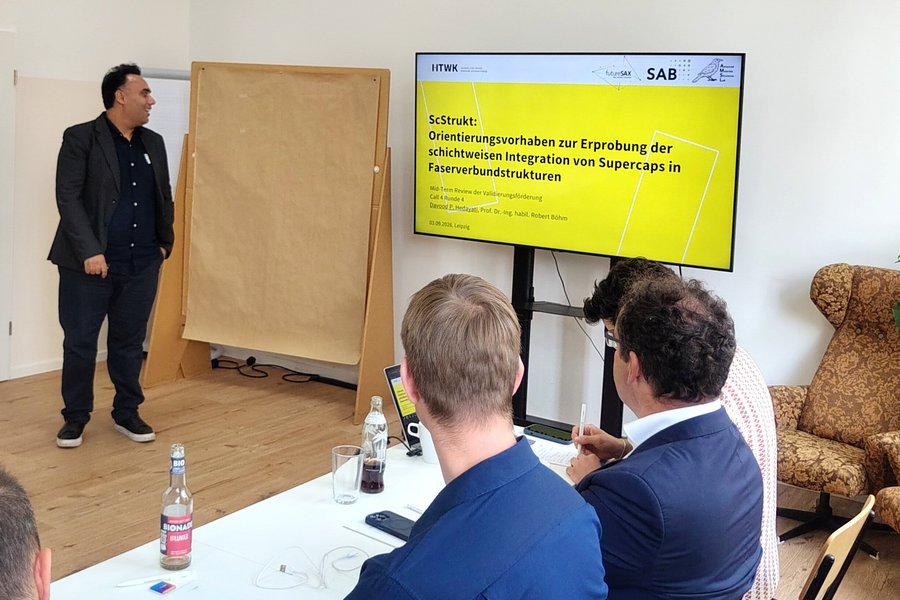
“Electric aircraft are currently limited primarily by the weight of their batteries: the energy storage system alone accounts for around 25 per cent of the total weight. Whether energy storage systems can be integrated directly into load-bearing components without compromising their mechanical strength has, until now, scarcely been investigated systematically. The ScStrukt project has tested precisely this: the layer-by-layer integration of supercapacitors into fibre-reinforced composite structures, with the aim of combining the structural element and the energy storage system in a single component,” said Hedayati.
Innovative approach has already been recognised at HTWK Leipzig
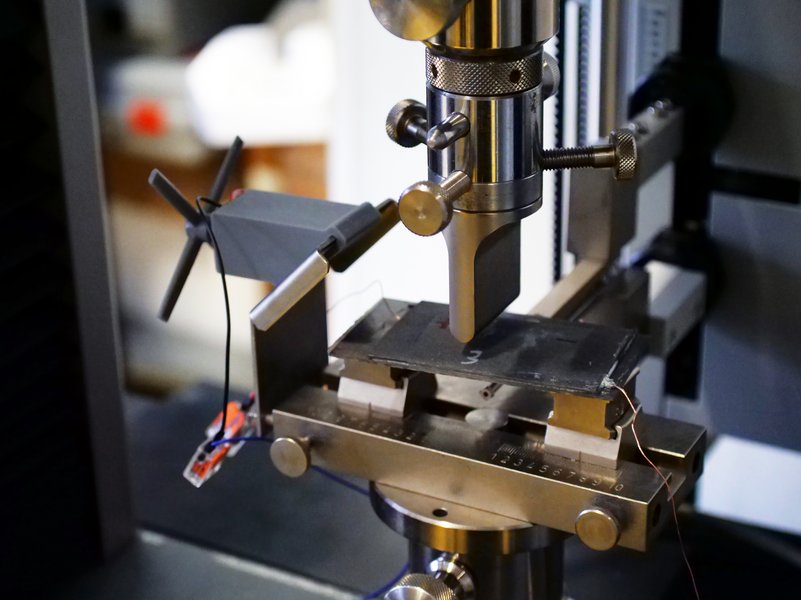
und treibt gleichzeitig einen Propeller an (Foto: Anika Schreyer/HTWK Leipzig)
During the funding phase, the AMSL team carried out stress tests on structural supercapacitors. In these bending tests, the test specimen bears a mechanical load whilst simultaneously driving a propeller. The results showed that the structure and the energy storage system function simultaneously.
Their innovative approach in the field of battery-free flight systems was recognised as early as June 2026 at the ‘Research Meets …’ networking event, where it was awarded the first Ideas Prize by the HTWK start-up consultancy Startbahn 13.
However, the AMSL research group is not only concerned with the development of innovative materials, such as structurally load-bearing energy storage materials and nanoparticle-reinforced plastics. It is also working on FEM-based design tools and application-oriented research for various industrial sectors, including transport, aerospace, energy and environmental technology, construction, medical technology and electrical engineering.
Background information on the Free State of Saxony’s funding for validation
Through this validation funding, the Saxon State Ministry for Economic Affairs, Labour, Energy and Climate Protection aims to assess the potential for applying innovative scientific research and to provide targeted support for the transfer of research findings. The aim is to ensure that research findings are put into practice more quickly.
