
The SieWo research project drew attention to the issues of domestic violence and the housing shortage at the Science Cinema event in Leipzig on 9 September
One in four women experiences violence in a relationship at some point, according to the findings of a European survey. Just how difficult it is to break the cycle of domestic violence and regain control of one’s own life – which includes having a safe home of one’s own – became clear at theScience Cinema event on 9 September 2025 at the Zeitgeschichtliches Forum in Leipzig.
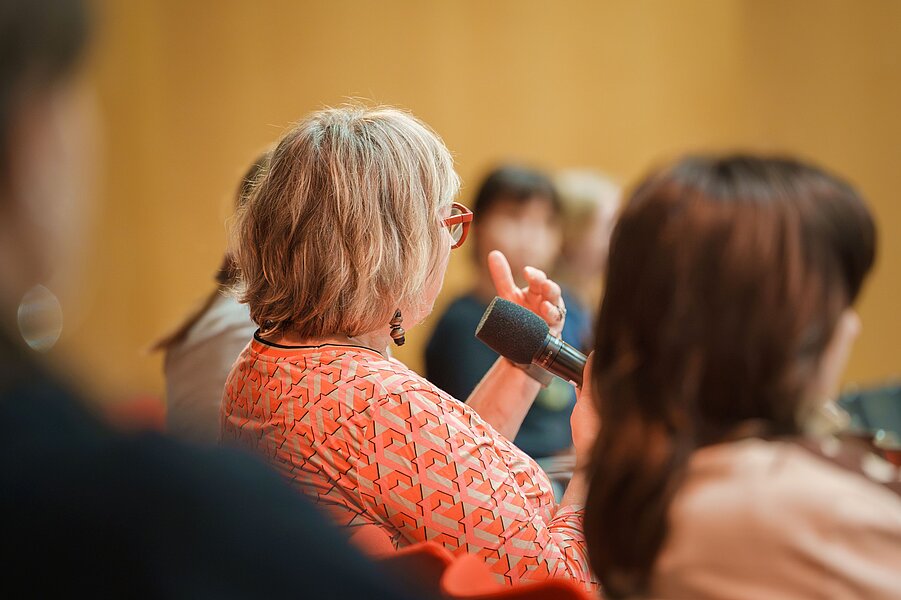
To address these two pressing social issues – domestic violence and the housing shortage – visitors were first shown the documentary ‘Zuflucht nehmen’ and then had the opportunity to discuss them with the guests: Researcher Dr Friederike Frieler from HTWK Leipzig, practice partner Ursula Baur from the association Kontaktstelle Wohnen, Lisa Rechenberg from the LAG Gewaltfreies Zuhause Sachsen association, and Mandy Uhlig, the City of Leipzig’s municipal equal opportunities officer, answered questions posed by presenter Katrin Haase from HTWK Research Communications.

The situation in the film is comparable to that in cities such as Leipzig

The 2023 film *Zuflucht nehmen* (Seeking Refuge) by director Selina Höfner addresses the Berlin housing market: the protagonists describe how various structural problems affect the situation of women affected by violence. For instance, there is a shortage of safe havens on which women affected by violence depend. This is also accompanied by the loss of existing safe havens as a result of displacement caused by evictions, rent increases and gentrification.
When asked whether the situation in Berlin is comparable to that in Leipzig, the panellists unanimously answer in the affirmative. According to Baur, there is also a severe housing shortage in Leipzig’s housing market; affordable housing in particular is difficult for marginalised people to find. The development of women’s shelters has also followed a similar pattern, as Uhlig explains: An independent women’s shelter was also established here in the 1990s. Today, there are four further women’s shelters, which are funded by the state. Whilst protection against violence remains a voluntary responsibility for local authorities, it is mandatory at state level. Since January 2025, the new Violence Protection Act has also been in force, which means that from 2032 onwards, victims will have a legal right to protection and counselling, and the federal states are obliged to expand their support services. Under the Istanbul Convention, there must be at least one family shelter for every 10,000 residents. In Leipzig, she said, they are already in a good position.
SieWo research project: Support and awareness-raising
Nevertheless, further support and research are needed. The research project ‘SieWo – Sie wohnt gewaltfrei’ is a good example of this. Through SieWo, this joint project between HTWK Leipzig and the non-profit organisation Kontaktstelle Wohnen is establishing a housing referral service for survivors of domestic violence. In this way, women seeking a fresh start after staying in a women’s refuge are matched with private or commercial landlords. A campaign running since spring 2025 is raising awareness of this initiative. The first placements have already taken place, as Baur reports in response to a question from the audience.
HTWK researcher Frieler adds: the information and awareness-raising campaign, which is aimed at commercial and private landlords, is the most important element of the joint project. In addition, however, this pilot project for social innovation also aims to understand what ‘safety’ actually means in relation to housing for people affected by violence; at the same time, the new findings can be used to make recommendations on further areas for improvement. Figures and studies are particularly important for demonstrating the need for support, as Rechenberg emphasises.
Public pressure is helpful in this regard: speaking out, getting involved, highlighting needs. A question from the audience tied in with this: What can the City of Leipzig do to support such initiatives? Uhlig wants to advocate for housing development tailored to needs and also raise awareness of the issue within the city administration. After all, everyone agrees on this: the length of stay in women’s refuges – usually more than four months, and often up to a year – is very long. Various social services, such as the Jobcentre or the health service, should cooperate more effectively in this regard, respond more quickly and receive further training on protection against violence, as the aim is to help women affected by violence as quickly as possible and, where appropriate, to help them return to a home of their own, thereby paving the way for them to resume a safe, self-determined life.
Next event
The next screening in the ‘Science Cinema’ programme – the film and discussion series organised by Leipzig’s scientific institutions – will take place on 25 November 2025: the film *Contagion* (USA, 2011) will be shown at the Zeitgeschichtliches Forum Leipzig. Admission is free.
SieWo project nominated for the SINN Innovation Award – online voting runs until 17 October 2025
The SieWo project has also been nominated for the SINN Innovation Award. The award recognises particularly innovative projects with a social impact in Saxony. Anyone interested can vote for one of the ten nominated projects until 17 October 2025.
