
At the International Conference on Web Engineering, a paper by PhD student Jonas Gwozdz and Prof. Dr Andreas Both was recognised – the result of a collaborative PhD programme between HTWK Leipzig and the Leipzig-based company Netresearch GmbH.
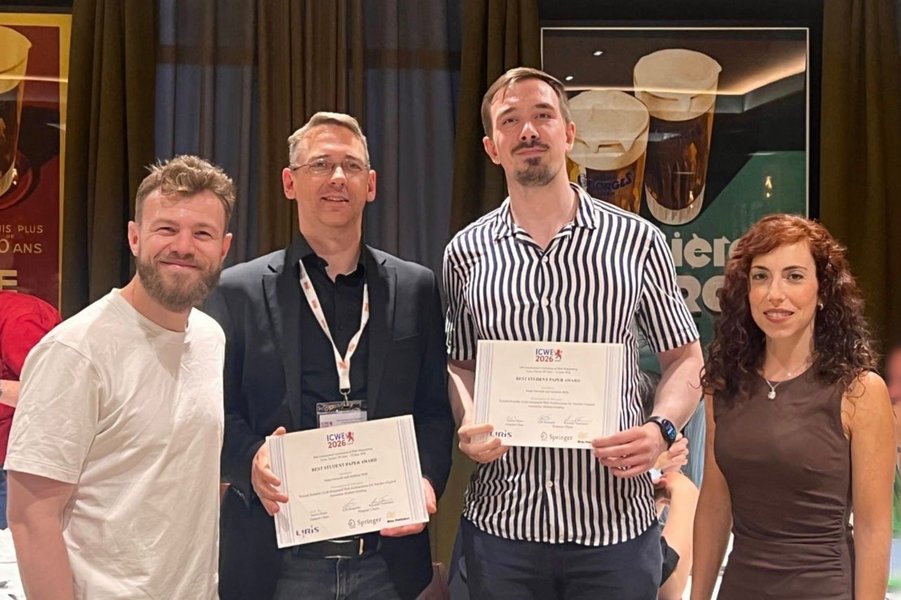
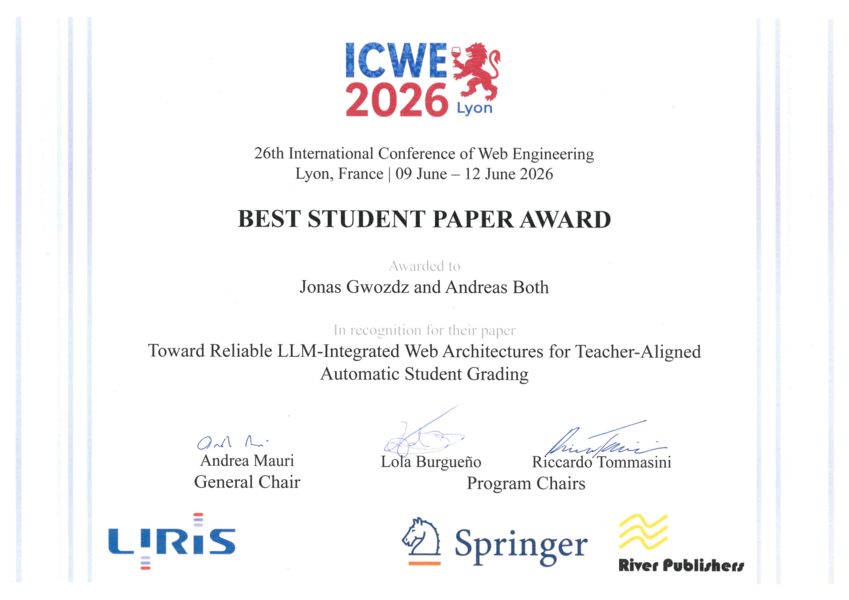
The Web & Software Engineering research group (WSE Research website) at the Faculty of Computer Science and Media at HTWK Leipzig has been honoured at the International Conference on Web Engineering (ICWE) 2026 in Lyon, France: the two researchers received the conference’s Best Student Paper Award for their publication. The award-winning paper is entitled “Toward Reliable LLM-Integrated Web Architectures for Teacher-Aligned Automatic Student Grading” and was authored by Jonas Gwozdz and Prof. Dr Andreas Both (Head of the WSE Research Group) and will be published in Springer’s Lecture Notes in Computer Science series. Jonas Gwozdz is himself a Master’s graduate of HTWK Leipzig and is currently in the second year of his PhD (hence the Best Student Paper Award).
Can generative AI mark exams – whilst still leaving the final decision on marking to the teacher?
Large language models (LLMs) are increasingly being used in the education sector. The marking of examination performance is a particularly sensitive issue in this context: marks have direct consequences for students’ future educational and career paths, must be justified in a transparent manner, and must be legally valid. An assessment awarded independently and opaquely by generative AI (Large Language Models, LLMs) is therefore neither desirable nor permissible.
This award-winning work addresses precisely this issue. It answers the question of how LLMs can be embedded within a web architecture without the teacher relinquishing control over the assessment. Rather than allowing the model to judge freely, it is systematically aligned with the assessment criteria of the respective teacher – the human remains the benchmark and the final authority, whilst the AI takes on the time-consuming preparatory work. The approach is therefore not aimed at replacing teachers, but at providing tangible relief from a task that takes up a considerable amount of time in everyday school and university life, whilst retaining the teacher’s context-specific assessment criteria.
Validation using real examination data
A key feature of this work is its practical relevance: the approach was tested not on fabricated examples, but on real, anonymised examination data. In the best configuration, the automatically determined assessments corresponded with the teacher’s marks to around 91 per cent. The research thus demonstrates that reliable, teacher-centred assessment support is technically achievable – an important step towards trustworthy AI applications in education.
In addition to the award-winning paper, Jonas Gwozdz presented his ongoing research agenda at the conference’s PhD symposium under the title ‘Toward Trustworthy, Teacher-Aligned Adaptive Learning on the Web’.
“The results show just how much is possible in this field – and, at the same time, how much still remains to be achieved,” says Jonas Gwozdz. “Reliability, traceability and the transferability to other subjects and task formats are open questions on which we will continue to conduct intensive research. In the long term, our research agenda aims to contribute to the development of trustworthy learning assistants – that is, systems that reliably support both sides: teachers in assessment and learning support, and learners through individualised, transparent feedback.”
Half of the PhD completed in-company: the Pro.Motion programme
This award-winning research was carried out as part of a Pro.Motion doctoral position at HTWK Leipzig. The programme combines academic training with industrial practice: PhD candidates spend half their time at the university and half at a partner company, and are supervised accordingly by two mentors – a professor at HTWK Leipzig and a mentor within the company. The time spent at the company is explicitly dedicated to knowledge transfer: New research findings are tested there as quickly as possible and put into practice – and the insights into what works in practice and what real-world challenges arise there feed directly back into the research at HTWK Leipzig. In the case of Jonas Gwozdz, the partner company is Leipzig-based Netresearch DTT GmbH.
“For us, shared funding is far more than just a funding model,” says Prof. Dr Andreas Both. “Half the time our PhD students spend at the company is not time away from research – it is knowledge transfer time. New findings are put to the test and applied there without delay, and what we learn in the process about their viability and the actual challenges faced in practice feeds directly back into our research questions. Knowledge and research transfer thus does not take place at the end of the project in a final report, but every week and in both directions. Both sides benefit from this – and, above all, research itself benefits: it becomes more relevant and its findings more robust. It is precisely this highly productive exchange – in this case with Leipzig-based Netresearch DTT GmbH – that simultaneously strengthens Leipzig as a centre for business and science; and the fact that this has resulted in internationally acclaimed work demonstrates that practical relevance and scientific excellence can go hand in hand.”
Repeated recognition on the international stage
For the WSE research group, this is already the sixth award for a scientific publication in the past 2.5 years alone. This latest award underlines the outstanding quality and high relevance of the research being carried out at HTWK Leipzig in the field of artificial intelligence (AI) and its application in web and information systems.
Publication
Gwozdz, J., & Both, A. (2026). Toward Reliable LLM-Integrated Web Architectures for Teacher-Aligned Automatic Student Grading. In: Web Engineering: 26th International Conference, ICWE 2026, Lyon, France. Lecture Notes in Computer Science, Springer. Access resource
