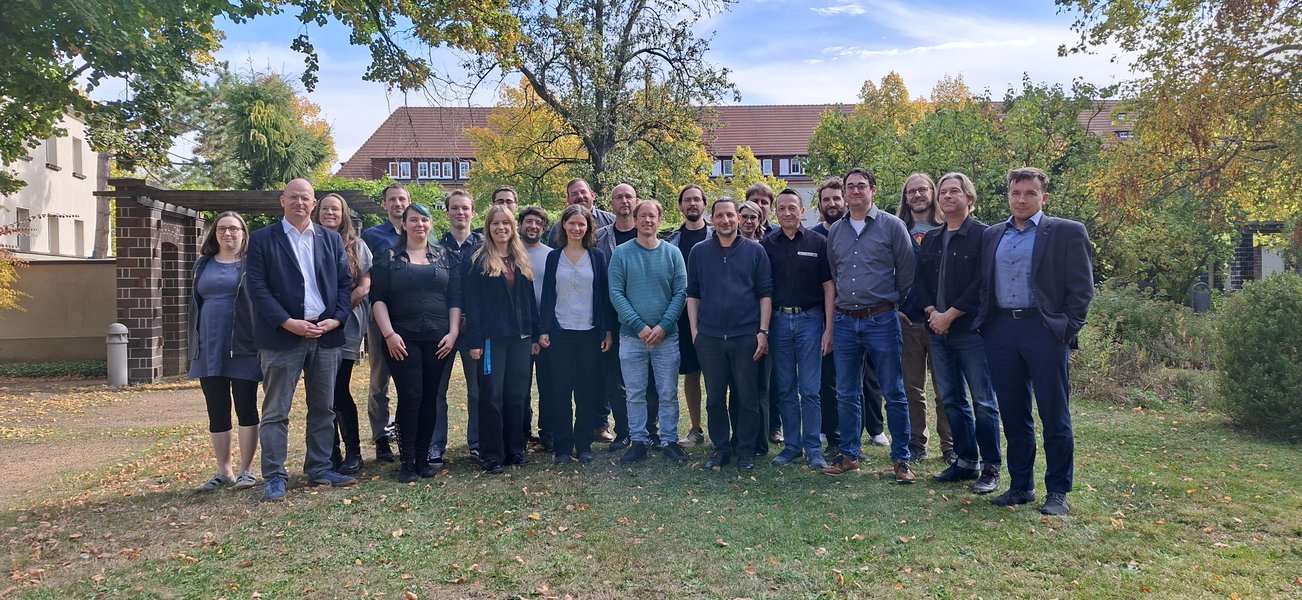
A research project to develop innovative technology for catheter positioning was launched in September 2026.
At the kick-off meeting for the BMFTR-funded research project NeoQKat (Novel Quantum Photonic Measurement Technology for Neonatal Catheter Positioning) at the end of September 2026, the consortium’s scientists gathered at the ICCAS (Innovation Centre for Computer-Assisted Surgery) to plan the next steps, further refine key areas of focus and explore opportunities for collaboration.
Over the next three years, the team led by Prof. René Sallier from the Faculty of Engineering at HTWK Leipzig will be working alongside its research partners in the NeoQKat project to develop a novel technology for catheter positioning based on purely quantum-optical magnetic field sensors. The safe positioning of catheters in premature babies poses a particular challenge, as minute anatomical structures, high heart and respiratory rates, and the often unreliable detection of the catheter tip using ultrasound make it difficult to determine its position precisely. With NeoQKat, the teams aim to use innovative photonic approaches to enable a significantly more precise and robust determination of the catheter’s position – thereby opening up new possibilities for medical application in neonatology.
The research findings will provide scientific validation of the novel localisation method and form the basis for its further development into a clinically applicable catheter-tracking system as part of the collaborative project.
The consortium of the NeoQKat research project
- Faculty of Engineering, HTWK Leipzig – Project leader: Prof. René Sallier
- Leipzig University Medical Centre, Innovation Centre for Computer-Assisted Surgery (ICCAS)
- Martin Luther University Halle-Wittenberg, Centre for Diagnostic and Interventional Ultrasound
- Friedrich Schiller University of Jena
- Leibniz Institute for Surface Modification e.V.
- duotec GmbH
- Quantum Technologies GmbH