Project management

- Section:
- FING
- Phone:
- +49 341 3076-1162
Further development of the wheel hub motor – a promising alternative to a centrally mounted electric motor
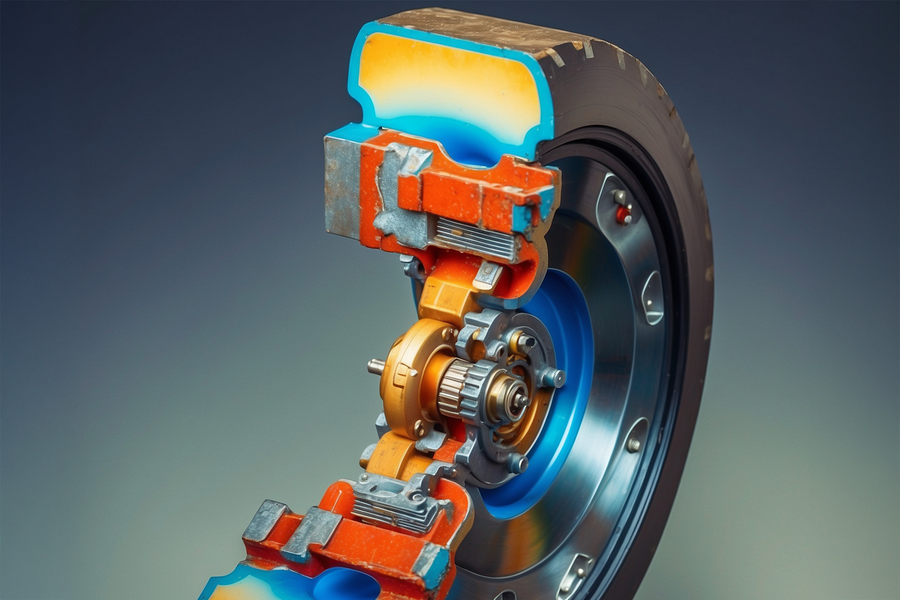
One of the major unresolved social challenges of our time is combating climate change. To tackle this, it is crucial to reduce emissions of greenhouse gases. As the transport sector is responsible for a significant proportion of climate-impacting gas emissions, electric vehicles play a vital role in reducing them. In almost all commercially available electric vehicle systems, the electric motors drive the vehicle’s axles, similar to the design of internal combustion engines. The differential and gearbox required for this increase the vehicle’s weight and take up space.
A promising alternative is the wheel hub motor, in which the electric motor is integrated directly into the wheel. This design allows certain components of the conventional powertrain to be omitted and opens up new possibilities in vehicle design. Furthermore, it potentially offers the possibility of controlling each wheel individually, which could enable an active ESP system and enhance safety.
A disadvantage of wheel hub motors is the high unsprung mass, which has so far prevented this drive technology from being used without restriction in motor vehicles. The additional weight in the wheel impairs the suspension characteristics and thereby reduces driving dynamics. The ARageriuM project aims to address this problem by reducing the unsprung mass. The approach aims to avoid the use of rare-earth magnets in order to minimise system costs and increase independence from non-EU countries. The goal of installation space neutrality also allows for the continued use of a conventional friction brake and enables the retrofitting of existing vehicles with an electric drive.
The project is being carried out in cooperation with Cologne University of Applied Sciences and RODING Mobility GmbH. Various motor topologies are being considered, such as switched reluctance motors, rare-earth-free permanent magnet synchronous motors, and synchronous reluctance motors. The motors are designed with an axial flux configuration. Furthermore, a motor test bench specially adapted for this project is being developed. Finally, the motors will be installed in a vehicle for testing and demonstration purposes.
Project team
- Section:
- FING
- Phone:
- +49 341 3076-1162
Funding