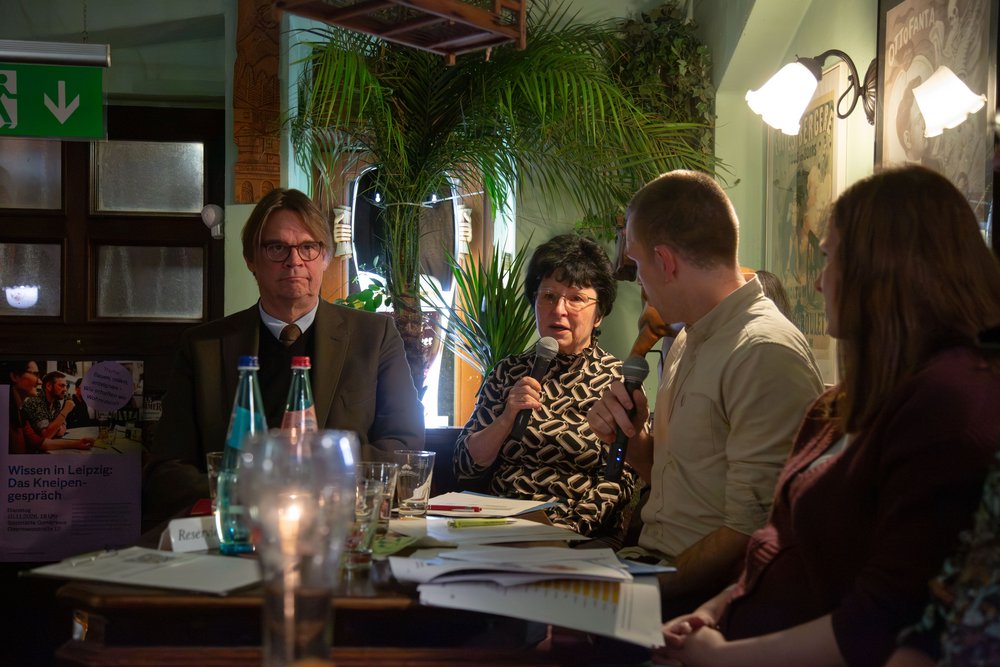
At the Leipzig pub discussion, Simons discussed ways of tackling the housing shortage with experts and members of the public. His view: without rising rents, the problem cannot be resolved in the long term

How can housing remain affordable when there is a shortage of accommodation? And which housing policy measures actually help? These questions took centre stage at the City of Leipzig’s ‘pub discussion’ on 10 November 2026. At the Gambrinus pub in Leipzig-Lindenau, Prof. Dr Harald Simons, Professor of Economics at HTWK Leipzig and Chairman of the research and consultancy institute empirica, discussed these issues with Jana Naerlich from the Office for Housing and Urban Regeneration and Dr Andrea Schultz from the Office for Statistics and Elections. The audience was also invited to ask questions and take part in the discussion.
Harald Simons put forward the view that some rents must rise in order for housing to remain affordable in the long term. His argument: “Rents of 6 euros per square metre are, quite simply, anti-social rents, because they encourage the waste of living space. Anyone with a very old tenancy agreement pays very little, because these existing rents have risen only slightly. But anyone looking for a flat has to pay a great deal. The result is that nobody is terminating their old tenancy agreement, and so hardly any flats become available for those seeking accommodation. That is the reason why we cannot find a flat.”
Also a guest on ‘Bosetti Late Night’

Just how controversial the issue of affordable housing is, and how varied the proposed solutions are, was also evident on television just a few days earlier: on 8 November, Harald Simons appeared as a guest on the 3sat programme “Bosetti Late Night”.Together with Ines Schwerdtner, chair of Die Linke, he discussed the housing crisis with presenter Sarah Bosetti and whether the nationalisation of large housing companies could be a solution.
There, too, Simons brought his academically grounded perspective to the debate. Among other things, he questioned whether a socialised housing stock would be economically viable. In doing so, he countered the notion that affordable housing can be achieved primarily through interventions in ownership structures and rent levels.
Both events made it clear that the issue of affordable housing cannot be resolved by a single housing policy measure. What is needed is an objective discussion on how more housing can be created and how people on low incomes can be effectively supported.
Photos from the pub discussion