
In a number of projects, researchers at HTWK Leipzig are testing, measuring and communicating how green roofs make cities more resilient to heat, heavy rainfall and biodiversity loss. An overview.
A hot summer’s day in Leipzig. The air shimmers over the streets, whilst the tarmac and concrete trap the heat. Hours later, the weather takes a turn for the worse: a violent thunderstorm rolls in, with heavy rain lashing down on houses, streets and squares. Within minutes, the drains are at breaking point. Scenes like these are becoming more common and pose growing challenges for towns and cities. One of the solutions lies where you’d least expect it: on the rooftops.
Which roofs really make a difference?
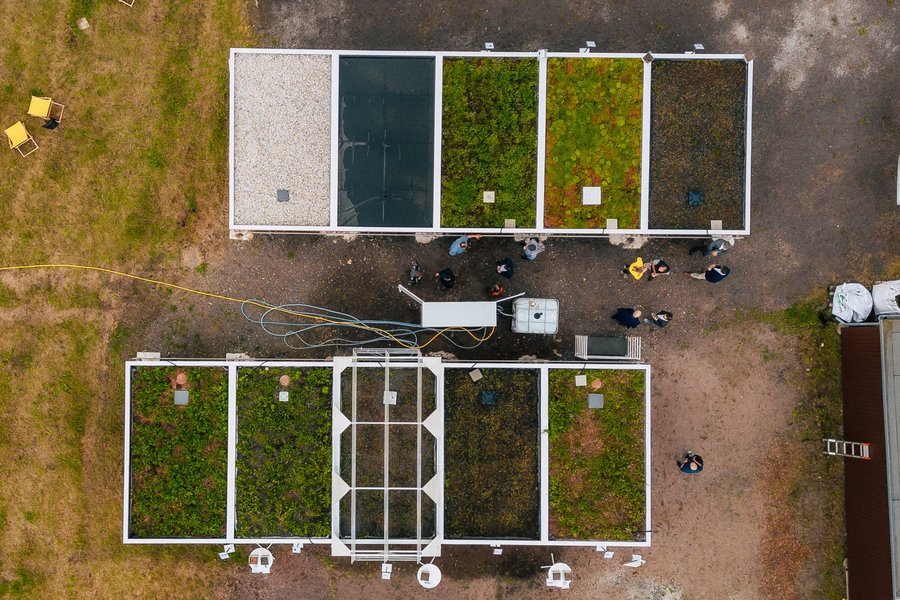
Green roofs store water and regulate the urban climate. However, the extent to which they do so varies greatly, ranging from extensively vegetated lightweight roofs with succulents to intensively vegetated garden roofs with perennials. That is why, since 2024, a test facility has been in operation on the outskirts of Leipzig, comprising two conventional flat roofs and eight research green roofs – these form part of a large-scale experiment funded by the German Federal Environmental Foundation. In the ‘MaNuGrün’ research project, the Education and Demonstration Centre for Decentralised Infrastructure, HTWK Leipzig, the Helmholtz Centre for Environmental Research, Leipzig Waterworks and Dresden Urban Drainage are investigating how different roof structures cope with heavy rainfall.
For a year, the roofs were not only exposed to natural weather conditions but were also subjected to targeted rainfall: with volumes of water corresponding to extreme rainfall events occurring once, five times and once every hundred years. Sensors measured how much water the substrate stored and how much ran off the roofs. From this, the researchers calculated the delay and the volume with which the water would theoretically flow into the sewer system. “The aim of water-sensitive urban development is to achieve a balance between evaporation, runoff and groundwater recharge – much like in nature. Rainwater should be retained, allowed to evaporate or seep away. Green roofs are an effective way of achieving this,” says Hubertus Milke, HTWK professor and head of the Institute of Hydraulic Engineering and Urban Water Management. “With this research project, we are establishing a robust foundation and generating simulation parameters that will help water utilities to realistically incorporate green roofs into their planning,” adds his research assistant, Friederike Wensch.
Since the project concluded in March 2026, it has been established that an intensive green roof with flow restriction – also known as a retention green roof – stores the most water and also delays the flow of water into the sewerage system for the longest time. Retention devices fitted to the roof outlet create a backwater effect. This causes the water to drain away with a time delay – which relieves the strain on the sewerage system during heavy rainfall. However, the project partners agree that which green roof is most suitable where always depends on local needs and possibilities. The measurement data now serves as a reliable basis for decision-making for local authorities, the housing sector and policymakers, ensuring that green roofs are installed where they deliver the greatest benefits.
High-tech solutions for healthy urban green spaces
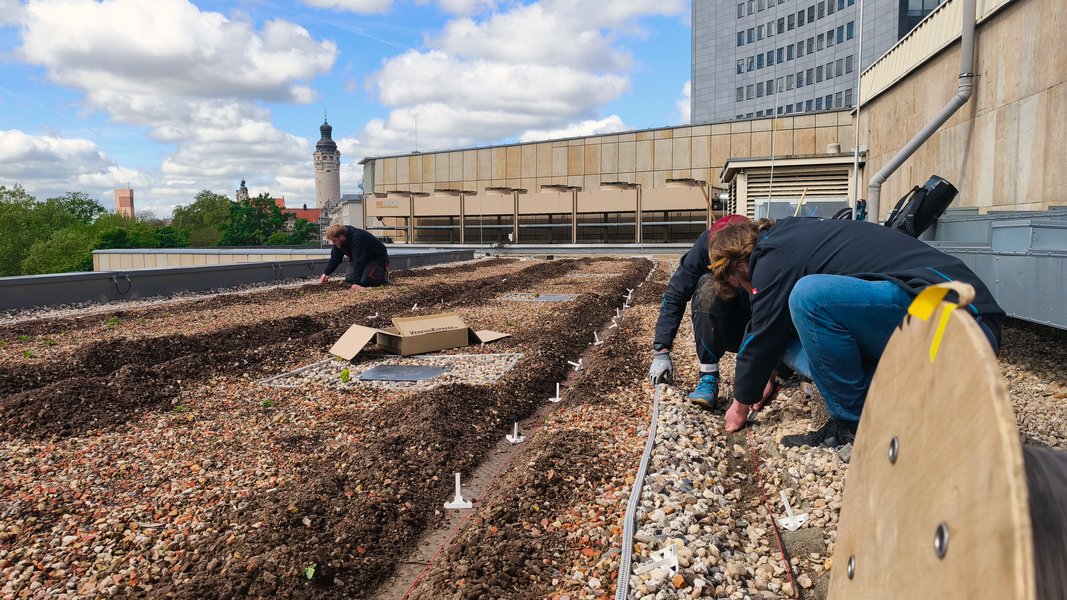
Research is also being carried out right in the heart of Leipzig – on the roof of the Gewandhaus. Where there used to be gravel, there is now greenery. Invisible to concert-goers, but of great interest to scientists: fibre-optic sensors in and on the substrate measure temperatures and provide indications of drought stress in the plants. “This allows us to identify very precisely when and where the green roof is becoming too dry,” explains Dr Martin Weisbrich, head of the ‘Sensors and Monitoring’ research group at the Institute of Concrete Structures at HTWK Leipzig. “This allows for targeted watering – not according to the ‘scatter-and-pray’ principle, but precisely where it is really needed.”
With the construction of the green roof, the Gewandhaus 2025 also made itself available to major regional scientific institutions as a research laboratory: The ‘ValiGrün’ research project, a joint initiative involving the Helmholtz Centre for Environmental Research, HTWK Leipzig, Dresden University of Technology and the Leibniz Institute for Tropospheric Research, is developing recommendations for action and optimisation for local authorities and private individuals. Previous empirical analyses have shown in some instances that the desired effects – such as cooling, increased biodiversity or water retention – did not always meet expectations. The data now being collected is intended to make the actual impacts of green roofs measurable. Findings from the project, which is funded by the Free State of Saxony and the European Union, are intended to help public and private developers optimise green roofs and plan on the basis of reliable data – thereby enhancing the effectiveness of green roofs in improving the urban climate.
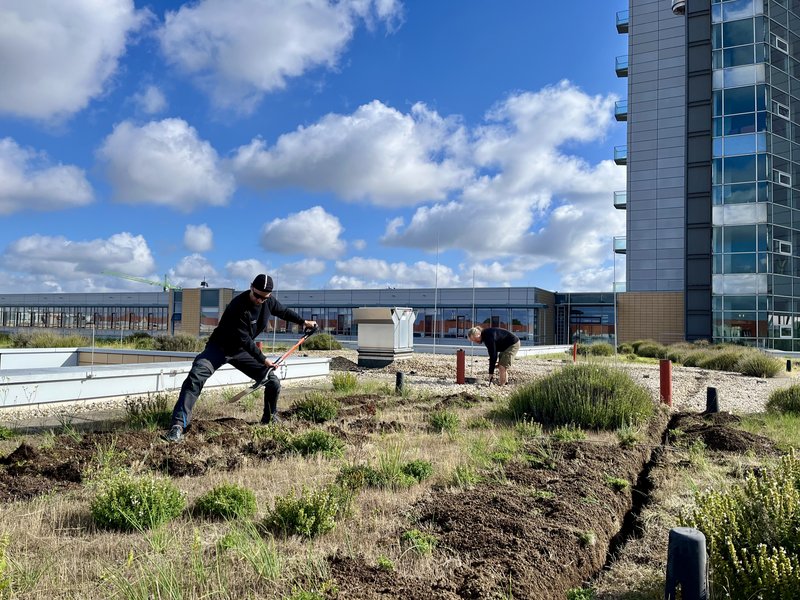
Meanwhile, as part of the ValiGrün project, the ‘Sensors and Monitoring’ research group has also fitted the roof of the MDR television station with fibre-optic sensors. Measurements were then taken on the green roof in October 2026.
Learning from green bus stops
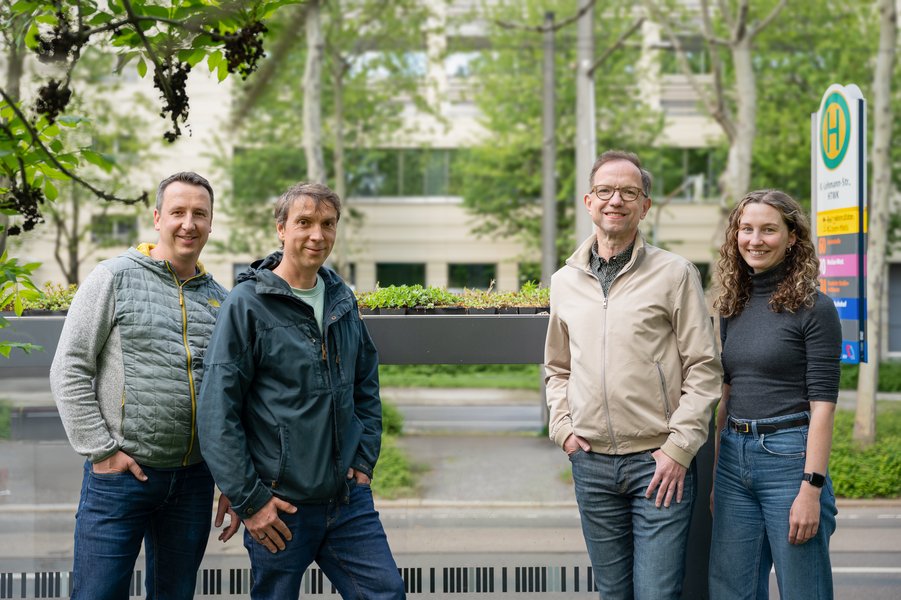
It is not only researchers in Leipzig who are measuring the impact of green roofs on the climate and biodiversity: as part of the ‘FaGULab’ educational project, school classes are studying the green roofs of public transport shelters under supervision. Using modern sensor technology, they measure environmental parameters, observe plants and insects, and analyse the data together.
“FaGULab motivates young people to take action. They collect real data, develop their own ideas and play an active role,” says Mathias Rudolph, HTWK professor of industrial measurement technology and head of the project, which is also funded by the German Federal Environmental Foundation. It combines education, research and urban development and demonstrates what citizen participation can look like in practice. Beyond the school-based measurement campaign, a real-world laboratory is to be designed. Partners from academia, public administration, business and civil society are developing practical greening strategies for this purpose. The aim is to translate the findings into concrete recommendations for action to promote biodiversity in urban development.
More than just green
Whether it’s a pilot plant, a concert hall or a bus stop: the projects in Leipzig show that green roofs make an important contribution to more climate-resilient cities. They store water, cool buildings and promote biodiversity – provided they are used and maintained effectively. Research projects are now providing reliable data to inform well-considered decisions in politics and business.
This article first appeared in the research magazine *Einblicke 2026* and has been updated here.
