
Robot football: At the 2026 RoboCup in Incheon (South Korea), the HTWK Robots took silver
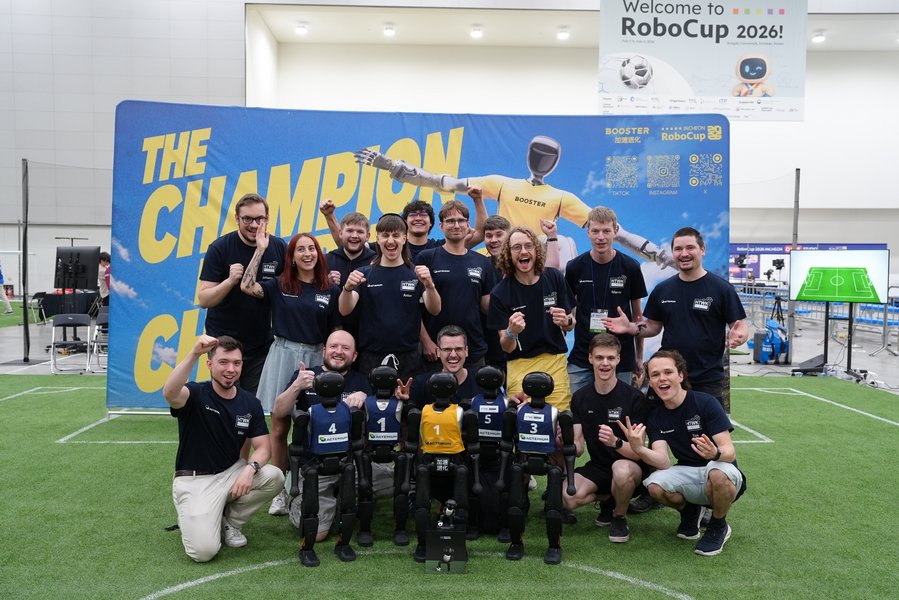
The robot football team from the Leipzig University of Applied Sciences (HTWK Leipzig) finished as runners-up at this year’s RoboCup in Incheon, South Korea: After a strong tournament, the HTWK Robots eventually lost 0–6 to Team B-Human from Bremen in the ‘Middle Division’ of the ‘Humanoid Soccer League’. As a result, the Leipzig team had to relinquish their title from the previous year.
“Whilst we managed to hold on to a 0–2 deficit for much of the first half, our goalkeeper unfortunately had to pick the ball out of the net four more times in the second half,” summarised Tobias Jagla from the Robots team. With B-Human and the HTWK Robots, the two German teams finished at the top of the table; they have dominated international robot football in their leagues for years and have frequently faced each other in the finals. The bronze medal was secured by the French team “Rhoban”.
The Robots team had been preparing intensively for the RoboCup World Cup since March; for around a year, the football-mad computer scientists at HTWK Leipzig had been working with the humanoid robots from the Chinese company Booster Robotics. The Booster K1 robots are larger than the Nao robots, with which the team competed at the very top of international competitions for more than 15 years up until 2025.
Among the team’s greatest successes are the world championship titles in 2018 and 2025, as well as eight runner-up titles. The team also secured the runner-up title at the first World Humanoid Robot Games in Beijing in 2025 with the Boosters.
“We’ve mainly been practising movements: we can now run even faster, and we’ve got a new shot and a new pass. Unlike in the past, behaviour is no longer programmed directly, but has been practised in simulation. This is achieved using various AI methods such as ‘reinforcement learning’ or ‘imitation learning’. We’ve also revamped our image recognition. We play with the original FIFA balls – either adult-sized or children’s-sized, depending on the size of the robots. The next step will be team strategy, where we’ll then build on the new movements,” says Jagla.
Successful collaboration
“Within a very short space of time, the collaboration with Booster Robotics from China has solved a number of technological problems for which we were unable to find European partners. For us, the collaboration is both motivating and stimulating. The progress we’ve made in recent months is equivalent to several years’ worth of work. I’d like to thank the team and everyone who has supported us – especially Booster Robotics – for their passionate work,” says Jens Wagner, HTWK Professor of Mobile Robotics and one of the supervisors of the HTWK Robots.
HTWK Rector Prof. Dr.-Ing. Jean-Alexander Müller is also proud: “I would like to congratulate our team wholeheartedly on coming second! My thanks go to everyone involved – both those on site and the researchers who stayed at home. The team’s consistent success over so many years demonstrates the outstanding research and development achievements of HTWK Leipzig and our alumni in the field of artificial intelligence and robotics. This impressively illustrates how we translate research into practical applications at our university.”
The hardware: Booster robots
The Booster K1 robots, which are approximately one metre tall and weigh 20 kilograms, are humanoid robots manufactured by Booster Robotics in Beijing. Thanks to a partnership, this new hardware has been available to HTWK Leipzig since April 2025. The HTWK Robots team used artificial intelligence to teach the robots how to walk, dodge obstacles, navigate, stand up and score goals. One of the robots successfully made its European debut in 2025 at the Leipzig Company Run.
At the end of August, the Robots team will be heading back to Asia: from 22 to 26 August, they will be competing at the World Humanoid Robot Games in Beijing, just as they did last year.
Background: RoboCup
At the RoboCup, university teams from all over the world compete against each other annually in various leagues. The HTWK Leipzig team competed in the ‘Humanoid Soccer League’ in the ‘middle’ and ‘large’ size categories in 2026.
The principle is that all teams use the same models. The challenge therefore lies in the programming – which is why robot football is also referred to as the ‘battle of the algorithms’. The HTWK team consists of 26 members, who are either studying at HTWK Leipzig or, as graduates, are already working. Fourteen of them travelled to South Korea, along with four booster robots.
This research and the successful competitions are made possible thanks to the support of various partners, including main sponsor Actemium and the Friends of HTWK Leipzig.
The stated aim of the RoboCup is for football robots to defeat the reigning flesh-and-blood world champions by 2050.
In South Korea, a total of more than 2,000 participants from 21 countries competed against one another in 62 teams.
