
Controlling robots, making clay bricks, learning about smart materials and printing on table tennis balls – that was the Long Night of Science 2023
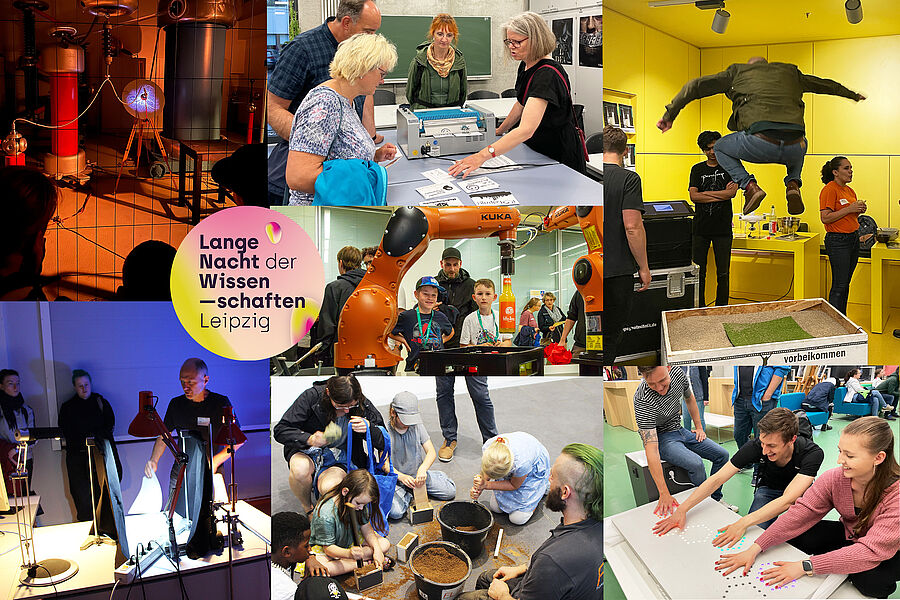
“My children are absolutely thrilled; they’d now love to study either mechanical engineering or printing and packaging technology,” said one mother after attending the Long Night of Science at HTWK Leipzig. Enthusiasm for the various teaching and research areas was sparked in a fun and engaging way on this Friday evening: Around 50 hands-on activities and exhibits to touch and try out, as well as guided tours of laboratories that are usually off-limits and fascinating talks, awaited visitors of all ages on 23 June 2023 from 6 pm at the University of Applied Sciences. A resounding success, as many of those involved later agreed.
With an extensive, varied and interesting programme, the participating researchers provided insights into the breadth of teaching and research areas at HTWK Leipzig. At the same time, the programme formed part of a total of more than 600 individual events hosted by over 54 science venues on the evening of the Long Night of Science in Leipzig.
Exhibits to try out and a glimpse into laboratories that are otherwise off-limits

At HTWK Leipzig, buildings on the central campus on Karl-Liebknecht-Straße and Gustav-Freytag-Straße, as well as in the Zentrum-Süd area on Wächterstraße, were open. For example, children and adults at the Nieper Building on the central campus were able to jump into a sandpit to experience soil compaction, build a small clay wall to promote greater sustainability in construction, and control small football robots created by the HTWK Robots Team, which have already become world champions in robot football. There were also numerous laboratories to explore: these included those dedicated to 3D printing, electrical engineering, materials research and the Institute for Hydraulic Engineering and Urban Water Management.

A few metres further on, the university library, the natural sciences laboratory building, the media centre and the Gutenberg Building also attracted visitors. There, they learnt in a fun and engaging way about the new composite material, carbon concrete, which not only promotes a more streamlined and sustainable approach to construction but can also be functionalised thanks to the electrical conductivity of the carbon. In addition, those interested learnt a great deal about the printing and packaging industry, which extends far beyond newspaper printing. “The children were absolutely thrilled. Amongst the adults, there was usually a lively discussion on the topics of packaging, packaging recycling and sustainability,” said Prof. Eugen Herzau, who revealed the “secrets of packaging technology” during his laboratory tours. Many visitors were also delighted to be able to take home a custom-printed table tennis ball or specially sealed gummy bear yoghurt pots. The chemists at HTWK Leipzig also provided insights into topics that are otherwise hidden from view during their laboratory tours, which showcased both ‘chemical detectives’ at work and the risks posed to works of art.

Further highlights awaited visitors at the Wiener-Bau on Wächterstraße: In the HTWK high-voltage laboratory, Prof. Carsten Leu demonstrated physics experiments that allowed interested visitors to experience the fascinating effects of electricity, including gas discharges in the air, sliding across surfaces and glowing in the so-called ‘gas chamber’. Also of great interest were the various sensors that guests could touch and try out, as well as the insights into medical technology and ChatGPT as a form of artificial intelligence.
The photo galleries and the short video provide further insights.
(Video editing: Paul Fischer/HTWK Leipzig)
