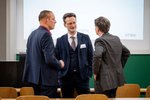
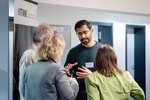
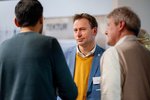
On 9 March 2026, representatives from the member institutions of the Leipzig Science Network and guests exchanged views on excellence in wood-based research

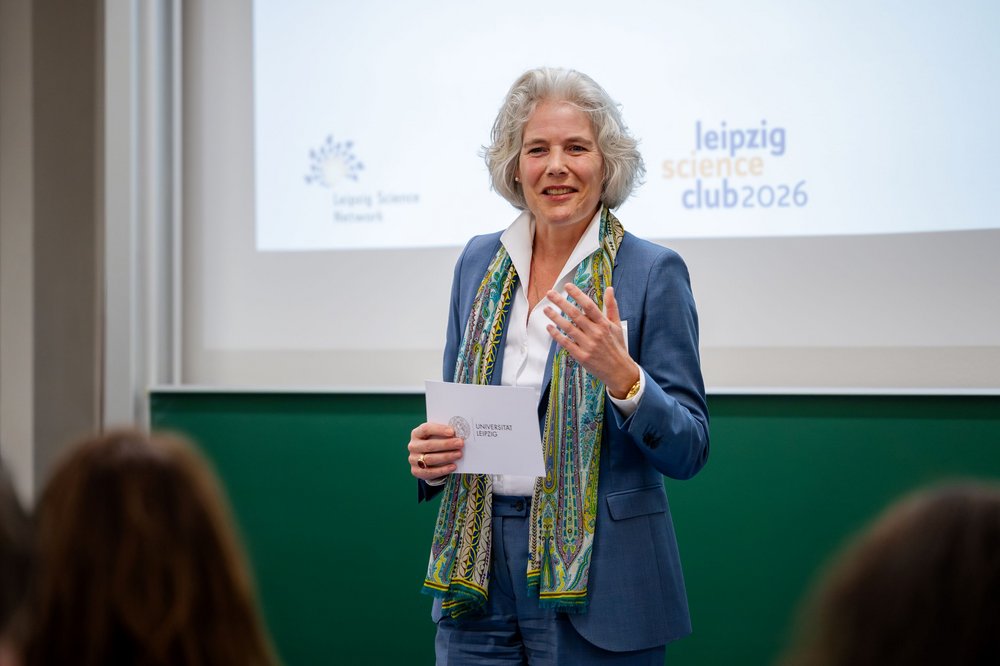
The Leipzig Science Club visited HTWK Leipzig for the first time: as part of the Leipzig Science Network (LSN) series of events, the heads of the LSN member institutions regularly exchange views on planned cluster initiatives and outstanding research in Leipzig as a centre of science, and network with one another. The topic on 9 March 2026 was wood as a resource – its uses and potential, as well as the conflicts associated with it.
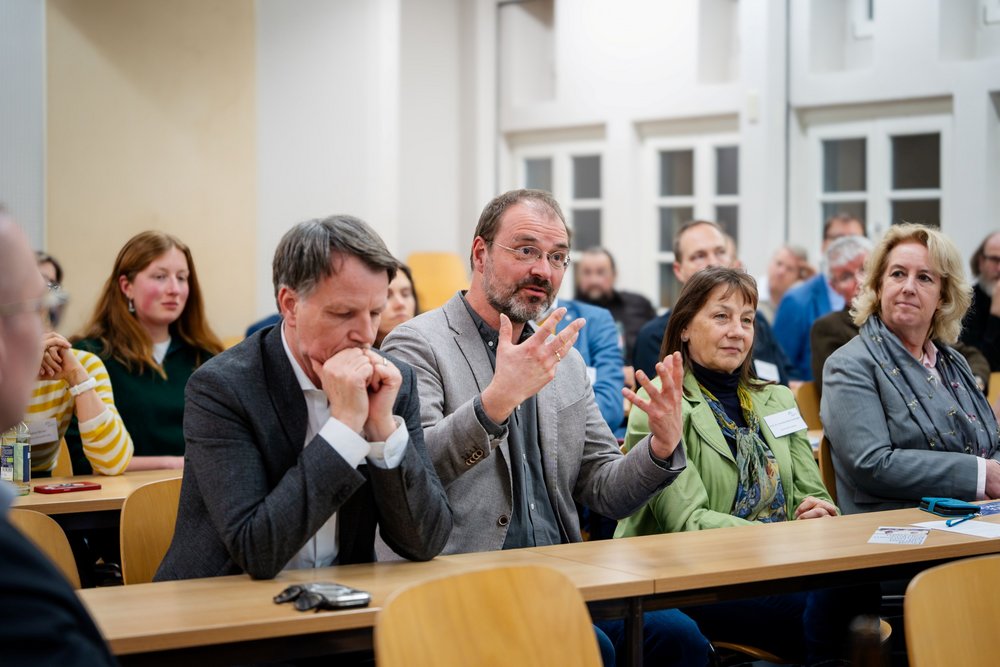
Around 50 invited representatives from LSN member institutions, as well as guests from the academic, civil society and politics took the opportunity during this inspiring evening to gain insights into current research, engage in interdisciplinary discussion and network, as wood – a sustainable resource – is equally important as a building material, a carbon sink and as part of recreational spaces.

“It was a great pleasure for me to welcome the partners of the Leipzig Science Network here at HTWK Leipzig. The evening provided a good opportunity to present our vision to the community and to demonstrate the potential we can unlock together within the network – in the field of timber construction, but also in numerous other areas,” said Prof. Dr Jean-Alexander Müller, Rector of HTWK Leipzig, after the event.
Wood as a building material, a carbon sink and a feature of recreational areas

Prof. Dr Alexander Stahr, Professor of Structural Engineering, Head of the FLEX Research Group and Scientific Director of the Timber Construction Research Centre at HTWK Leipzig, demonstrated in his lecture ‘Off the Beaten Track – Applied Research at the Timber Construction Research Centre at HTWK Leipzig’ that productivity in the construction industry is falling and that the timber-working trades, in particular, need a boost and support. The key drivers for this are automation, digitalisation and the use of AI. The focus should be on reusing timber that has already been used, for example by designing buildings to accommodate different uses – from car parks to residential buildings – because even a renewable resource is finite.

In her talk ‘Trees are good for you!’, Prof. Dr Aletta Bonn, Professor of Ecosystem Services at the Leipzig Centre for Environmental Research (UFZ/iDiv/FSU), made it clear that the biodiversity and climate crises are continuing to worsen despite political framework agreements. Urban green spaces have been proven to promote good health and are a real driving force behind physical and mental wellbeing: for example, bird diversity increases life satisfaction, and trees right on one’s doorstep have been shown to have significant positive effects. However, the health and social value of trees is currently not given sufficient consideration.

Prof. Dr Martin Quaas, Professor of Economics at the University of Leipzig and Head of the Biodiversity Economics Research Group at the German Centre for Integrative Biodiversity Research (iDiv) Halle-Jena-Leipzig, added an economic perspective in his commentary. According to him, wood has greater economic value in terms of CO₂ sequestration than through its use. Natural green spaces would increase the well-being of entire neighbourhoods; a recreational value of great economic significance.

Leipzig-based organisations are bringing together science, urban development and sustainability
In the joint discussion that followed, it became clear that the Central German economy is currently unable to cover the entire life cycle of timber utilisation. Forests are becoming more diverse and biologically rich once again. The timber industry is gradually adapting, but overall the situation is this: we must learn to make do with less timber. This is because timber is not a suitable building material for every application, but is particularly worthwhile in the housing and education sectors. One promising area of research is the impact of childhood and adolescent experiences in and with nature on later life. Wood imports from abroad remain sensible from both a sustainability and an economic perspective.
The guests used the inspiring insights gained during the subsequent reception at the Creative Club at HTWK Leipzig to engage in further discussions, including on potential research collaborations. “The evening demonstrated how science, urban development and sustainability are considered together in Leipzig,” said Kathleen Schlütter, Managing Director of the LSN, expressing her delight at the successful evening at HTWK Leipzig.