
HTWK Leipzig is developing a wireless sensor network designed to detect forest fires as early as possible and report them reliably. To achieve this, the researchers are combining energy-efficient radio technology with smart sensor technology.
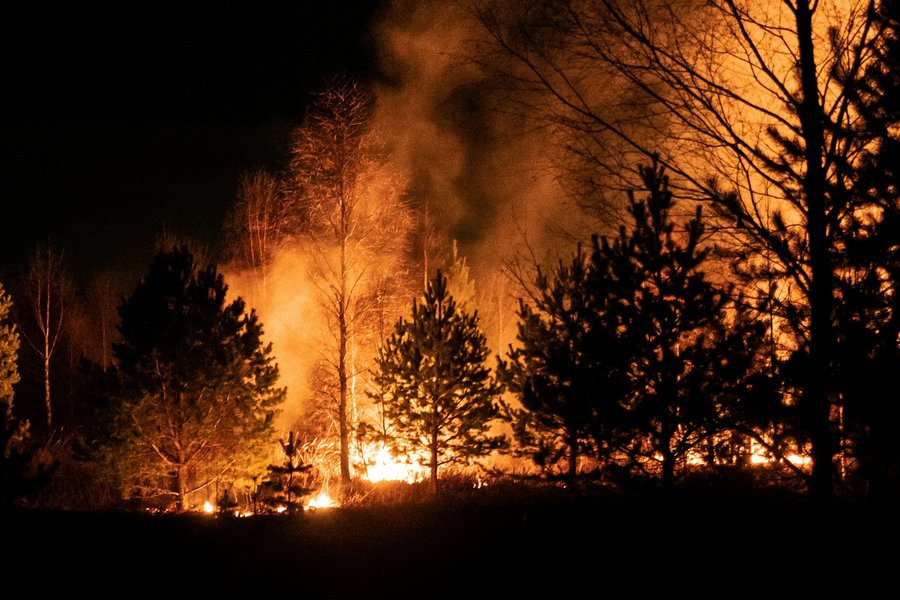
When a forest fire breaks out, every minute counts. The ZUBAT research project – ‘Future-oriented, wake-up-based, opportunistic IoT platform for early forest fire detection’ – run by HTWK Leipzig therefore relies on a dense network of small sensors that communicate wirelessly with one another. These sensors are designed to continuously monitor changes in the forest environment and, in the event of a fire, send an alert to the fire service as quickly as possible.
Two research groups at HTWK Leipzig are collaborating on the project: the Chair of Communications Engineering led by Prof. Dr.-Ing. Marco Krondorf and the Chair of Smart Diagnostics and Online Monitoring led by Prof. Dr.-Ing. Faouzi Derbel. The project will run from January 2025 to December 2028 and is funded by the Federal Ministry of Research.
Sensors are only activated when necessary
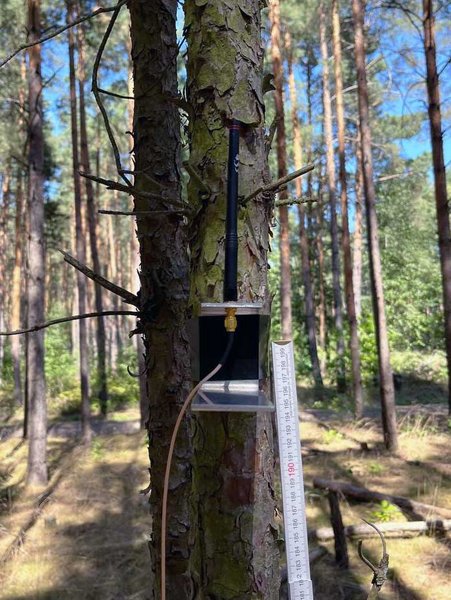
A particular challenge with this sort of sensor network is the power supply. The sensors should have as long a service life as possible, and battery replacement should be required as infrequently as possible. ZUBAT is therefore relying on so-called ‘wake-up receivers’: the sensors suspended from tree trunks can ‘wake each other up’ in a targeted manner when new information is required. This means that not all sensors need to be active at all times.
The communication system is designed to be up to 500 times more energy-efficient than established wireless technologies such as LoRa, whilst maintaining a high level of reliability. To achieve this, the scientists are developing a new transmission technology tailored to the requirements of early forest fire detection. This work builds on years of research by HTWK Leipzig into wireless sensor networks carried out by Prof. Derbel’s research group.
Several sensors check for fires
The project also employs a multi-stage approach when it comes to sensor technology. One sensor continuously measures particles in the environment. If their concentration exceeds a certain threshold, further sensors are activated. These check, for example, whether the particles are in fact organic. Sensors that measure carbon monoxide and carbon dioxide can then be switched on.
In addition, a microphone is designed to detect ambient noise. If human voices are recognised, further sensors can also be activated. The rationale behind this is that more than 90 per cent of forest fires are caused by humans. The combination of various measurement parameters is intended to help prevent false alarms and to classify suspicious changes more accurately.
Radio technology must work even in dense woodland
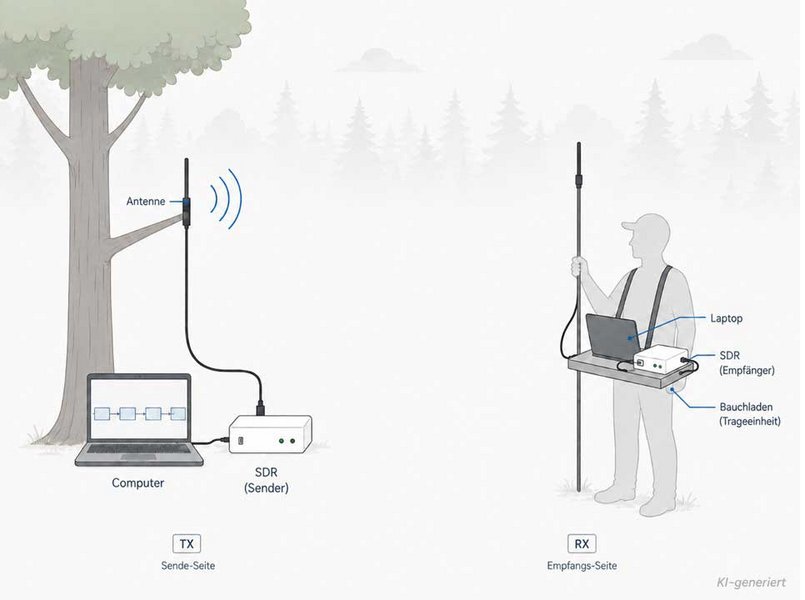
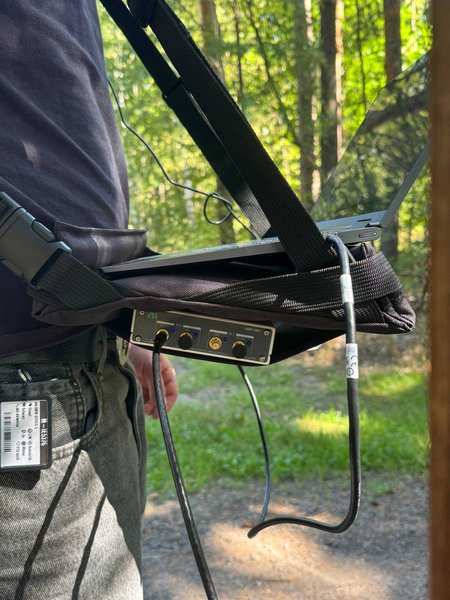
For the measurement data from the forest to reach a central base station, the sensors must communicate reliably with one another. This is a key focus of the research carried out by Prof. Krondorf’s team: the researchers are investigating the extent to which trees and other vegetation attenuate radio signals, and how a stable radio connection can nevertheless be established.
To this end, measurements have already been carried out at three locations – the Dübener Heide, the Leipzig floodplain forest and the Ore Mountains. For the measurements carried out so far, the project partner Sachsenforst has kindly made the forest areas available to the researchers. The team is currently using the measurement data to compile statistics on the probability and extent of signal attenuation in Saxony’s forests. At the same time, the communications engineers are developing a modulator with the appropriate algorithms and building the first prototypes of the forest fire transmitters.
From prototype to field trial in the forest

Following the technical tests and prototype development, a controlled test fire is initially due to take place next year on the grounds of HTWK Leipzig. Towards the end of the project, a controlled test fire is planned in a Saxon forest – in collaboration with Sachsenforst and the fire service.
The tests, simulations and measurements are intended to demonstrate the conditions under which the system operates reliably. In the long term, the research findings are intended to form the basis for technical standards for the early detection of forest fires.
