
HTWK Foundation Dissertation Prize
Below you can find out more about the previous prize winners and their doctoral research projects.
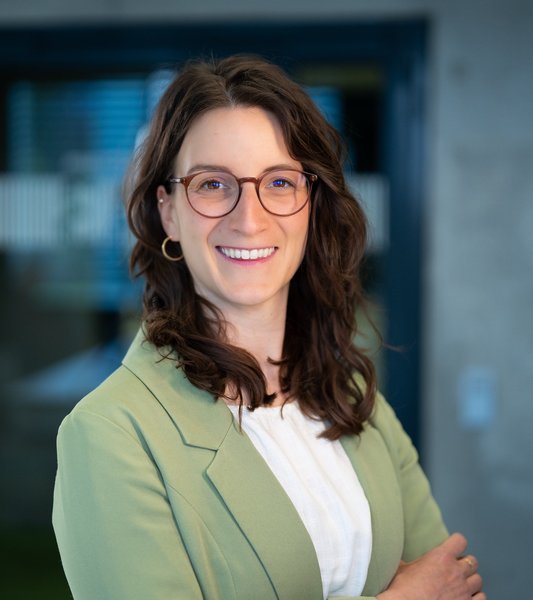
Dr. rer. pol. Ann-Kathrin Dieterle
Organisational Resilience in Companies
In 2026, the HTWK Foundation honoured Dr. rer. pol. Ann-Kathrin Dieterlewith the Dissertation Prize for her thesis entitled ‘The Role of Inter-organisational Cooperation for Resilience: An Analysis of Organisational Processes, Strategies, Practices, and Sources’. Conflicts, crises and dynamic developments – such as those caused by wars, pandemics or technological upheavals involving digitalisation and AI – present companies with major challenges: to cope with these unexpected changes, they must anticipate the altered conditions as quickly as possible, prepare for them and adapt their strategies in the long term. This ability is referred to as organisational resilience. Cross-organisational cooperation can also play a role here. In her thesis, Dieterle investigated how such cooperation can specifically help to build and practically implement organisational resilience. She also derived practical recommendations for action aimed at senior management within organisations.
Read more about the PhD project in the article ‘More Resilient Companies Through Collaboration’.
Watch the video about the PhD project on YouTube.
About the PhD thesis: “The Role of Inter-organisational Cooperation for Resilience: An Analysis of Organisational Processes, Strategies, Practices, and Sources”
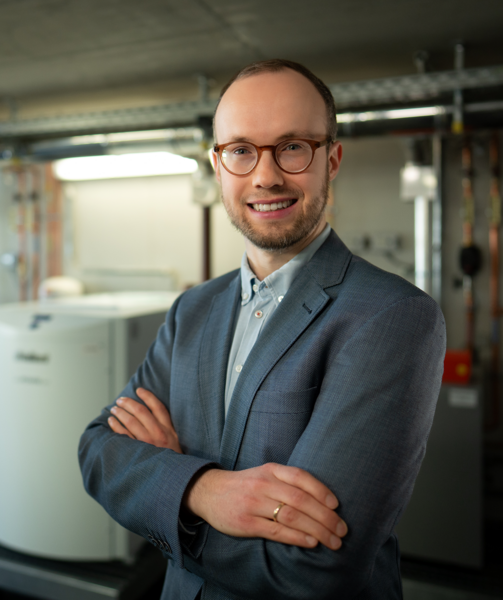
Dr.-Ing. Tom Radisch
Decision support for the early-stage planning of a building’s heating system
In 2025, the HTWK Foundation honoured Dr.-Ing. Tom Radisch with the Dissertation Prize for his thesis entitled ‘Comparison of heating system options in early planning phases using multi-criteria decision support’. In it, he developed a method enabling planners to identify the most suitable heating system for a building at an early stage. This method is based on multi-criteria decision support. Radisch thereby breaks down the complexity of the options and influencing factors to create a sound basis for decision-making. The choice of heating system should be made as early as possible in the planning process in order to keep costs and effort to a minimum. In a case study, he presents six possible heating systems for a block of flats as examples and demonstrates how building and system simulations can be used to assess, at an early stage, which heating system is best suited to the property.
Read more about the PhD project in the article ‘Which heating system is right for the house?’.
Watch the video about the PhD project on YouTube.
About the PhD thesis: “Comparison of heating system variants in early planning phases using multi-criteria decision support”.
Dr Christoph Oefner, rer. nat.
Improving the estimation of the service life of implants in human bone
In 2024, the HTWK Foundation awarded Dr. rer. nat. Christoph Oefner its Dissertation Prize for his thesis entitled ‘Computational service life analysis of an osteoporotic lumbar pedicle screw–vertebra assembly’. As part of this work, the mechanical engineer developed a digital predictive model for estimating the service life of implant fixations in human bone. He was also able to demonstrate the validity of such a model through experimental studies. The model he has developed will enable operations to be planned more effectively and tailored more specifically to individual patients in future. For the first time, doctors will be able to make concrete statements about the service life of implant fixations – a boon for patient safety.
Read more about the PhD project in the article “For greater stability in diseased spines”.
About the PhD thesis: “Computational service life analysis of an osteoporotic lumbar pedicle screw–vertebra assembly”
Watch the video about the PhD project on YouTube.
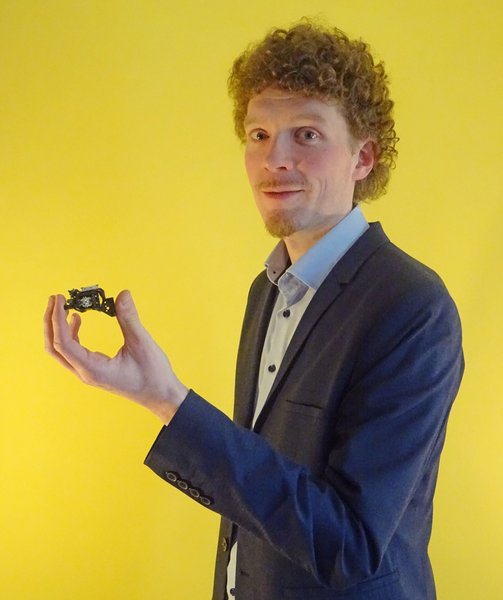
Dr Raphael al Diban, Eng.
Optical vibration diagnosis of machines and workpieces
In 2023, the HTWK Foundation awarded Dr.-Ing. Raphael al Diban its Dissertation Prize for his thesis entitled ‘The use of optical pickup units for condition monitoring in the context of a longitudinal turning process’. In his thesis, the qualified engineer develops a new method for vibration diagnosis in machines and workpieces. In industry, digitalisation and automation, it is becoming increasingly important to be able to diagnose conditions and monitor processes automatically. The new method can contribute to this.
Read more about the PhD project in the article “How a CD reader is helping research”.
About the PhD thesis: “The use of optical pickup units for condition monitoring in the context of a longitudinal turning process”
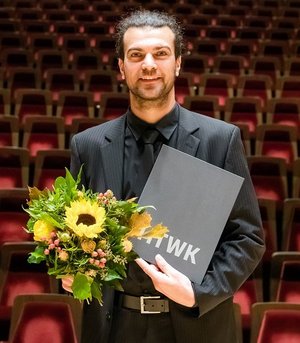
Dr.-Ing. Kai Bartholomäus
Use of passive elements to compensate for harmonic components in residual earth fault current and to generate frequency-selective earth faults
This year, the HTWK Foundation’s doctoral thesis prize, worth 3,000 euros, was awarded to Dr.-Ing. Kai Bartholomäus for his thesis entitled ‘Compensation of harmonic components in residual earth fault current and generation of frequency-selective earth faults using passive elements’. In his thesis, the electrical engineer develops a method for making the energy supply of electricity grids more efficient and safer, whilst also reducing susceptibility to faults. A patent application has been filed for the method, which has already been implemented more than 360 times. The work makes an important contribution to the energy transition, as the reliability of electricity supply networks is a particularly topical issue at the moment.
Read more about the PhD project in the article “Research for safe and efficient electricity grids”.
Doctoral thesis title: “Compensation of harmonic components in residual earth-fault current and generation of frequency-selective earth faults using passive elements”

Dr Tobias Flath, Eng.
Development of a twin-screw extruder dosing head for 3D printing and its potential, using bone substitute materials as an example
Patients who have suffered complex bone injuries and require implants could receive better treatment in future. As part of his doctoral thesis, Dr Tobias Flath developed a technology for 3D printers that enables the production of customised material mixtures. This opens up the possibility in medicine of incorporating medication into implants in future. The HTWK Foundation honoured him with the 2021 Dissertation Prize for this research achievement.
Read more about Tobias Flath’s PhD project in the article ‘New technology enables implants with additives’.
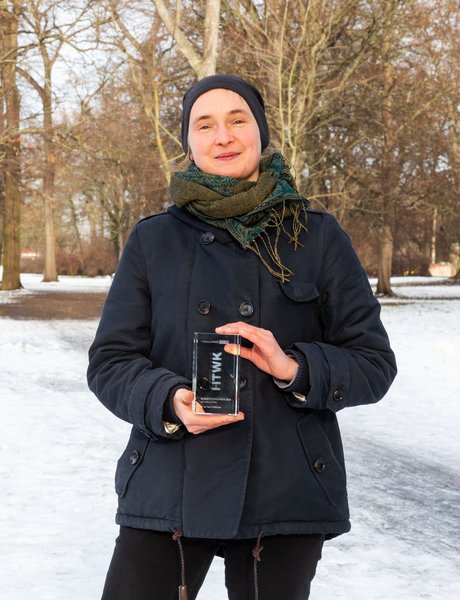
Dr Ulrike Igel
On the significance of social inequality and environmental factors in the development and prevention of overweight and obesity in childhood
“It is precisely those children who grow up in neighbourhoods with particularly high numbers of unemployed people or those with lower levels of education who are at greater risk of becoming overweight – regardless of their parents’ social status,” says Dr Ulrike Igel. In her doctoral thesis, she investigated the influence of social inequality and environmental factors on the body weight of girls and boys, and how residential areas can be designed to prevent overweight. The HTWK Foundation awarded her the 2020 Dissertation Prize for her innovative work in obesity research.
Read more about Ulrike Igel’s PhD project in the article ‘Does the neighbourhood influence children’s body weight?’.
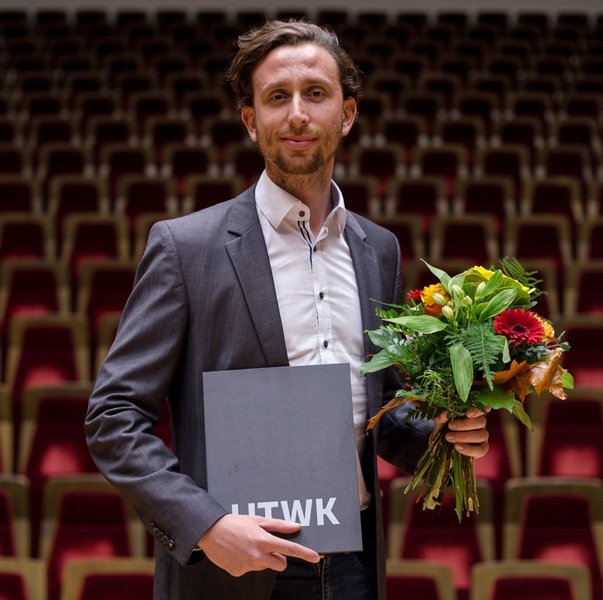
Dr Max Vollmering, Eng.
Damage Localisation of Mechanical Structures by Subspace Identification and Krein Space-Based H∞ Estimation
The HTWK Foundation’s 2019 Dissertation Prize has been awarded to Dr.-Ing. Max Vollmering for his dissertation: ‘Damage Localisation of Mechanical Structures by Subspace Identification and Krein Space-Based H∞ Estimation’. In it, Vollmering, who studied civil engineering at HTWK Leipzig, develops a method for the automatic detection of structural changes and early damage detection in buildings and installations. This year’s prize was sponsored by the energy supplier enviaM (Mitteldeutsche Energie AG).
Dr.-Ing. Max Vollmering is conducting research in the Mechanics/Dynamics research group led by Prof. Armin Lenzen, who is supervising the thesis, on a long-term experiment to identify mechanical structures as part of a project funded by the German Research Foundation (DFG). Vollmering first developed a theoretical damage localisation methodology, which he tested in laboratory experiments at HTWK Leipzig. The methodology developed and tested is of practical use in industry, as it enables structural damage to be preventively detected and localised whilst structures such as bridges or wind turbines are in operation between maintenance intervals. The award-winning doctoral thesis was examined by Prof. Carsten Könke (Bauhaus University Weimar), Prof. Christian Bucher (Vienna University of Technology) and Prof. Armin Lenzen (HTWK Leipzig).
Read more about Max Vollmering’s PhD project in the article ‘Dr Max Vollmering awarded the HTWK Foundation’s Dissertation Prize’.
And in the ‘Insights’ article ‘His method detects damage’.
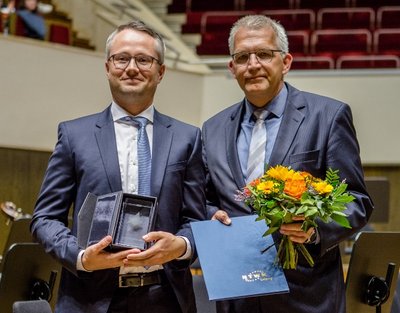
Dr Andreas Reinhold, Eng.
Improving the power quality of AC and DC networks
Dr.-Ing. Andreas Reinhold was awarded the HTWK Foundation’s Dissertation Prize in 2018. During the enrolment ceremony on 8 October, the HTWK Foundation honoured him for his doctoral thesis entitled ‘Theoretical investigation and simulation of an active filter system with a parallel-serial structure for six-pulse diode rectifiers’. In his doctoral thesis, Reinhold addressed the issue of power quality in electrical networks and the possibilities for improving it through active filters. The problem is that electrical appliances are often not ‘grid-friendly’, as they produce so-called harmonics that damage the power grid. Active filters – devices made from power semiconductors – generate counter-oscillations that compensate for these harmful oscillations. Thanks to Reinhold’s work, it will be possible in future to improve the power quality of both AC and DC networks simultaneously. This year, RTI Automation GmbH from Leipzig was secured as the sponsor of the dissertation prize; the company has been carrying out projects in the field of electrical and automation engineering for more than 20 years.
On the doctoral thesis: “Theoretical investigation and simulation of an active filter system with a parallel-serial structure for six-pulse diode rectifiers”
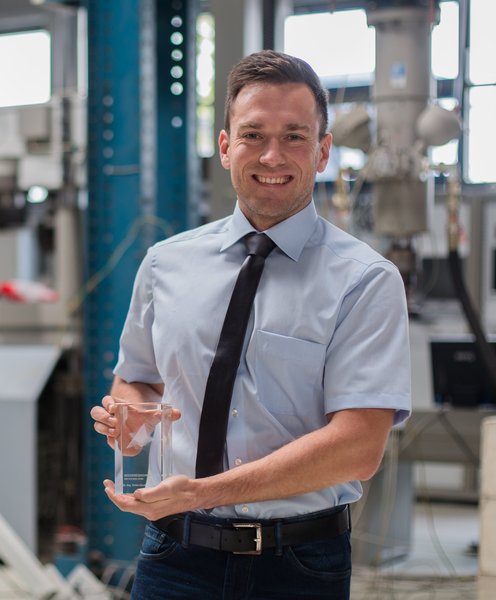
Dr.-Ing. Stefan Käseberg
Reinforcement of reinforced concrete columns with circular cross-sections by encircling them with CFRP materials
In order to add a new storey to a building or to enable a bridge to carry heavier loads, it may be necessary to reinforce the structures’ columns. Dr Stefan Käseberg investigated how this can be achieved with minimal use of materials as part of his PhD research. His thesis, awarded the distinction ‘magna cum laude’, establishes the engineering principles for the retrofitting of reinforced concrete structures using carbon fibre. According to his supervisor, Professor Klaus Holschemacher, he has thereby “found an outstanding solution to a current structural engineering problem”. For his doctoral thesis entitled ‘Reinforcement of circular-section reinforced concrete columns by encircling with CFRP materials’, he was awarded the 2017 Dissertation Prize at the HTWK Leipzig matriculation ceremony on 10 October 2017 at the Gewandhaus in Leipzig.
The HTWK Foundation’s Dissertation Prize has been awarded annually since 2014 to an outstanding doctoral thesis produced predominantly at HTWK Leipzig. The HTWK Foundation supports the Leipzig University of Applied Sciences for Technology, Business and Culture by raising and channelling funds to support and expand teaching and research. This year’s Dissertation Prize was sponsored by ‘Neue ZWL Zahnradwerk Leipzig GmbH’.
The doctoral thesis was published in 2016 in the Institute of Concrete Structures’ series and is also freely available in the Saxon open-access database Qucosa.
Dissertation: ‘Reinforcement of circular-section reinforced concrete columns by encircling with CFRP materials’, submitted to Dresden University of Technology.
Find out more about Stefan Käseberg’s doctoral project in the article ‘A corset for weak concrete columns’.
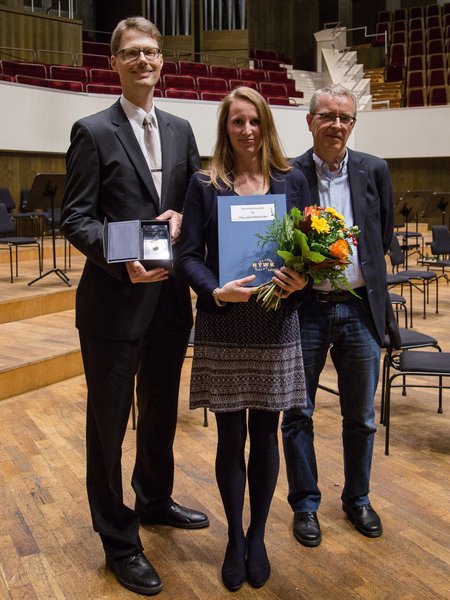
Dr Julia Dobroschke, PhD
Production processes for teaching materials in universal design, with particular regard to the needs of blind and visually impaired children in inclusive education
In 2016, the dissertation prize was awarded to Dr Julia Dobroschke. Her doctoral thesis, entitled ‘Production processes for teaching materials in Universal Design, with particular consideration of the needs of blind and visually impaired children in inclusive education’ was successfully defended in 2015 as part of a joint doctoral programme at the Faculty of Social Sciences and Philosophy at the University of Leipzig and the Faculty of Media at HTWK Leipzig, receiving the distinction ‘summa cum laude’.
Dobroschke developed a concept for making it easier to produce textbooks for visually impaired and blind children. This is because, despite the binding requirements of the UN Convention on the Rights of Persons with Disabilities, only a fraction of the books available to sighted people are adapted for blind and visually impaired users. For this reason, teaching materials for children often have to be created manually by parents and teachers. “Ms Dobroschke’s work aimed to avoid expensive, specialised accessible solutions by applying the principles of ‘universal design’,” the jury stated in its citation. Without requiring any significant additional effort, this approach not only produces accessible file formats but also modern forms of publication such as apps or e-books. Through her work, Dobroschke has made a “highly valuable contribution to the advancement of scientific knowledge”. Consistent implementation of ‘Universal Design’ benefits both sighted and visually impaired readers alike, explained Dobroschke, who works in contract management at the German Central Library for the Blind in Leipzig (DZB) as part of the BIKOSAX (Accessible Information and Communication Services in Saxony).
Doctoral thesis: ‘Production processes for teaching materials in Universal Design, with particular consideration of the needs of blind and visually impaired children in inclusive education’, submitted to the University of Leipzig.
Read more about Julia Dobroschke’s doctoral project in the article ‘Better books for blind and visually impaired pupils’.

Dr.-Ing. Torsten Müller
Investigations into the flexural behaviour of steel-fibre-reinforced concrete and steel-fibre-reinforced concrete with reinforcing steel, taking into account the influence of steel fibre type and concrete composition
The Dissertation Prize, awarded for the second time in 2015, was presented to civil engineer Dr.-Ing. Torsten Müller for his work on the flexural behaviour of steel-fibre-reinforced concrete. The PhD was completed through a collaborative programme at the University of Leipzig; the dissertation’s examiners were Prof. Nguyen Viet Tue (Graz University of Technology) and Prof. Klaus Holschemacher (HTWK Leipzig). The topic investigated in the thesis formed the basis for the prize winner’s successful start-up, ‘Baustoffprüflabor Müller & Lobisch GmbH’.
The Foundation’s Chairman, Dr Joachim Wicke, paid tribute to Müller’s achievement at the 2015 matriculation ceremony: “Applied research also leads directly to the establishment of businesses and to economic success. This year’s winner of the Dissertation Prize is proof of that.”
Dissertation: ‘Investigations into the flexural behaviour of steel-fibre-reinforced concrete and steel-fibre-reinforced concrete with reinforcing steel, taking into account the influence of steel fibre type and concrete composition’, submitted to the University of Leipzig.
Read more about Torsten Müller’s PhD project in the article “Applied research leads to business start-ups”.
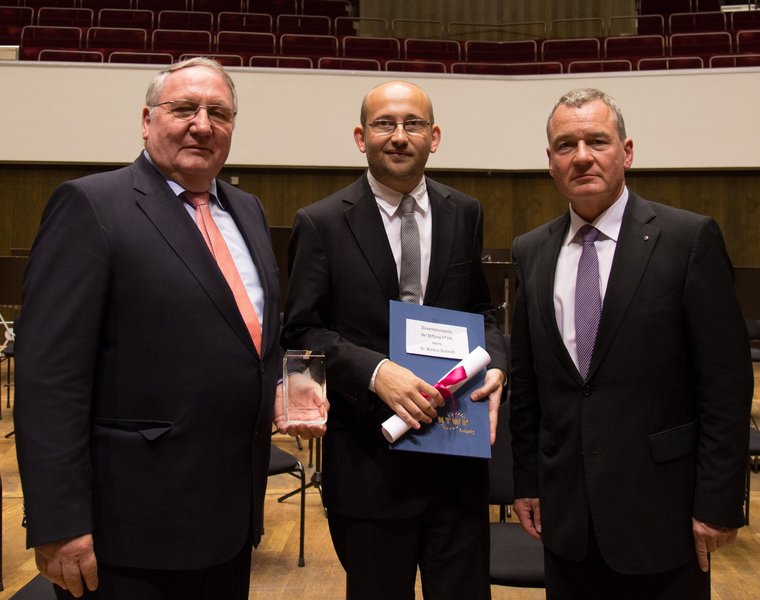
Dr Markus Schmidt
Early-age concrete curing based on capillary pressure measurement
The HTWK Foundation’s Dissertation Prize was awarded for the first time in 2014 for an outstanding doctoral thesis in one of the academic fields covered by HTWK Leipzig. The prize was awarded to civil engineer Dr Markus Schmidt for his work on preventing damage to freshly laid concrete. The PhD was completed as part of a collaborative programme with the University of the West of Scotland in Paisley.
Schmidt’s doctoral thesis, originally titled ‘Early Age Concrete Curing Based on Capillary Pressure Measurement’, was also the first thesis defended there by an HTWK graduate. Paisley is situated a few kilometres west of Glasgow, and the university partnership has been in place since 2003. “Last summer, Schmidt returned from Scotland with excellent results,” said Joachim Wicke at the award ceremony in the Gewandhaus. The chairman of the HTWK Foundation added: “Thematically, too, Markus Schmidt’s work is ‘incredibly relevant’.” Research into preventing cracks in plastic concrete is extremely useful for the future of the construction industry. It is therefore hardly surprising that work on this topic is set to continue.
“The research and writing the dissertation in English were challenging tasks,” says Markus Schmidt. The award winner now hopes that some of his findings will find their way into practical application.
Dissertation: “Early-age concrete curing based on capillary pressure measurement”, submitted to the University of the West of Scotland (UWS).
Read more about Marcus Schmidt’s PhD project in the article “HTWK Foundation’s Dissertation Prize awarded for the first time”.
