
HTWK Leipzig was once again able to maintain a high level of additional funding for research, knowledge transfer and teaching in 2025
In 2025, the Leipzig University of Applied Sciences (HTWK Leipzig) secured a total of 20.66 million euros in third-party funding. The university received these funds in addition to its regular budget from the federal government, the state, the European Union, the business sector and other funding bodies such as the German Research Foundation (DFG), thereby further establishing itself as one of Germany’s leading research-intensive universities of applied sciences. The third-party funding includes €4.48 million from the university’s Leipzig Research and Transfer Centre (FTZ), which acts as a link to the business community, as well as €2.96 million in endowment funds from Deutsche Telekom AG for the Faculty of Digital Transformation.
In total, the university and the FTZ employ 359 staff funded by third-party and special funds, who contribute to numerous research initiatives as well as to projects in student studies, teaching and administration, and 55 staff under the ‘Future Contract for Student Studies and Teaching’.
“For four years now, our university has consistently maintained the €20 million mark in securing third-party funding. This success demonstrates that, in the nationwide competition for additional funding, our researchers consistently put forward excellent and competitive ideas, thereby ensuring that HTWK Leipzig remains a research-intensive university in the long term. It is worth noting that around a quarter of these funds come from the private sector. This shows that the university and businesses strengthen one another, and that this transfer is successful even in economically challenging times and promotes stability,” says Prof. Dr.-Ing. Jean-Alexander Müller, Rector of HTWK Leipzig.
Prof. Dr.-Ing. Faouzi Derbel, Vice-Rector for Research and Sustainability at HTWK Leipzig, emphasises: “For the majority of the topics HTWK Leipzig is researching, there is a demand from industry, because as a university of applied sciences, we often conduct research in collaboration with partners from the business world. They work with us on solutions for which there is real demand and which usually result in practical products, services or technologies – that is what sets us apart and something we are proud of.”
Third-party-funded research projects
The largest share of third-party funding goes towards applied research projects; this funding enables the implementation of a wide range of ideas for solutions to future-oriented issues such as sustainability, digitalisation and the energy transition.
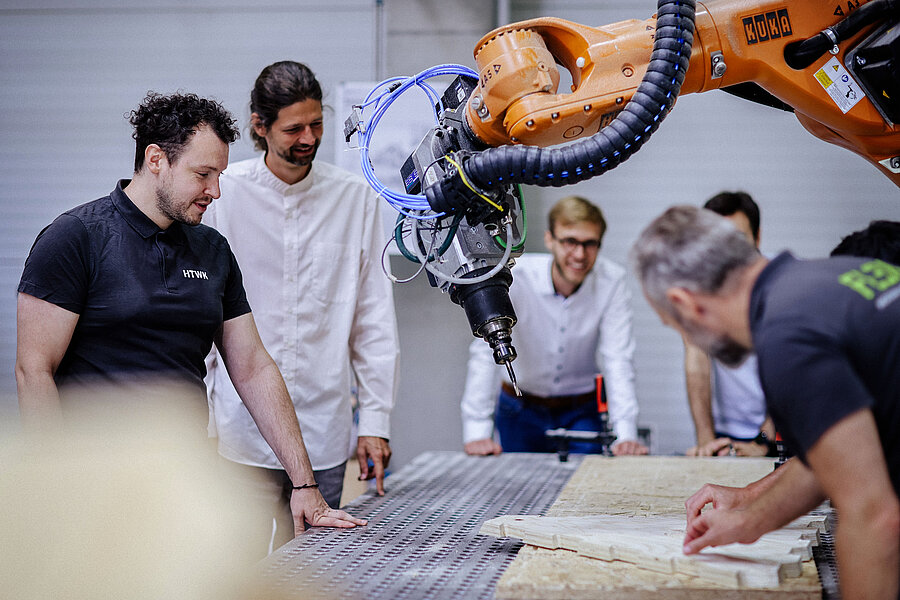
For example, the Federal Ministry of Agriculture, Food and Rural Affairs is funding the ‘TimberBot’ project, in which the interdisciplinary FLEX research group at HTWK Leipzig, in collaboration with numerous partners from academia and industry, is developing robots capable of precisely cutting and machining timber beams. The aim is to make timber construction more cost-effective, flexible and sustainable by minimising waste during processing and creating timber joints that are more readily reusable.
The ‘SieWo – Sie wohnt gewaltfrei’ project, a collaboration between HTWK Leipzig and the Kontaktstelle Wohnen, supports women and children who have experienced domestic violence as they make the transition from women’s refuges to a safe home of their own. The aim of the project is to find affordable housing, relieve the burden on support services and facilitate stable, long-term tenancies. The project is funded by the Saxon State Ministry for Social Affairs and Social Cohesion, as well as by the European Social Fund Plus (ESF+).
As part of the“TOUCAN-Evolution”project, funded by the Federal Ministry for Economic Affairs and Energy, engineers are working alongside partners from academia and industry to improve modern manufacturing processes for solar cells so that they can be produced efficiently and competitively in large quantities in Europe in future. To this end, they are optimising production processes using simulations – for example, to ensure that delicate silicon wafers are thoroughly rinsed in chemical baths and that the required gases are distributed evenly within the furnaces, thereby improving quality, yield and production speed.
Externally funded projects in teaching
HTWK Leipzig also carried out several projects in this area: for example, the university was a member of the Saxon joint project “studienerfolg@saxHAW”, funded by the European Social Fund. The funding period ran from April 2024 to June 2026. The aim was to improve academic success and counteract the expected shortage of skilled workers in the (Saxon) labour market. The project was aimed at young women and girls studying STEM subjects (Science, Technology, Engineering and Mathematics).
The Makers Lab gave schoolgirls from various year groups, as well as prospective students, an insight into the university, everyday student life and course content: programming, 3D printing, AI and robotics, experiments in the chemistry lab, soldering, building, designing and more were on offer.
The mentoringprogramme enabled students to network with women from academia and industry who had professional experience. A role model campaign raised the profile of women’s career paths. In addition, educational programmes for students were developed and established. The aim was to address gender-specific needs, attract more women to the male-dominated field of STEM professions and, in this way, help tackle the shortage of skilled workers in this sector.
Background
In total, HTWK Leipzig had a budget of 61.88 million euros in 2025. Of this, it received 41.22 million euros in budgetary funding from the Free State of Saxony. The additional €20.66 million in third-party funding breaks down as follows: in 2025, HTWK Leipzig received a total of around 46.2 per cent (€9.2 million) of its third-party funding from the federal government. Around 25 per cent (€5.16 million) came from regional and national companies, around 15.6 per cent (€3.22 million) from European Union funding programmes, and around 3.7 per cent (€0.77 million) from the Free State of Saxony. In addition, 9.5 per cent (€1.97 million) comes from sources including the German Academic Exchange Service and other public and private third-party funding providers.
