
HTWK students demonstrate how old wind turbine blades can make cities more resilient to climate change
In a few years’ time, many wind turbine blades will need to be replaced. But what will happen to all those end-of-life blades? How can they be reused and repurposed? In the design seminar ‘Climate-Friendly Building Construction – ReRotor’, Master’s students in architecture at HTWK Leipzig explored, during the summer semester of 2026, how cities and landscapes can be made more liveable and climate-resilient, and how old rotor blades can be utilised to achieve this. The students will present 10 models of façade designs on 22 and 23 July 2026 during the summer tour organised by the Faculty of Architecture and Social Sciences (FAS) at Karl-Liebknecht-Straße 145 (Lipsius Building), 04277 Leipzig, 4th floor.
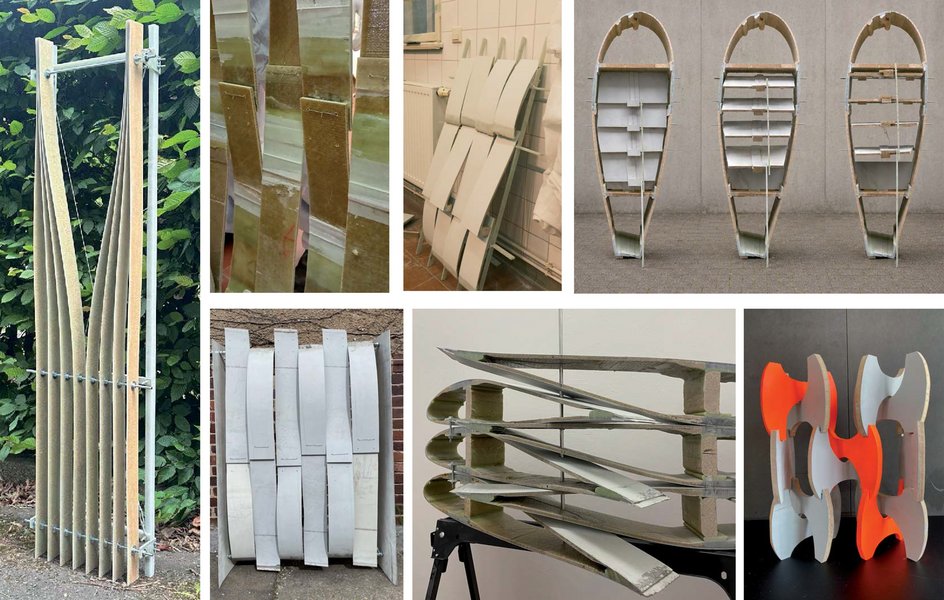
The material cycle as a topic in research and teaching
At HTWK Leipzig, the Composite Circularity Lab (CCL) at HTWK Leipzig is researching and putting into practice how a closed-loop composite material cycle can influence social and environmental issues, and how a complete material cycle with high-quality intermediate products can be achieved. To integrate this topic more strongly into application-oriented teaching, the ‘ReRotor’ design seminar was developed as a collaboration between the FAS and the CCL, supervised by FAS Professor Frank Schüler and CCL staff members Dr Pamela Voigt and Dimitrij Seibert in the workshop.
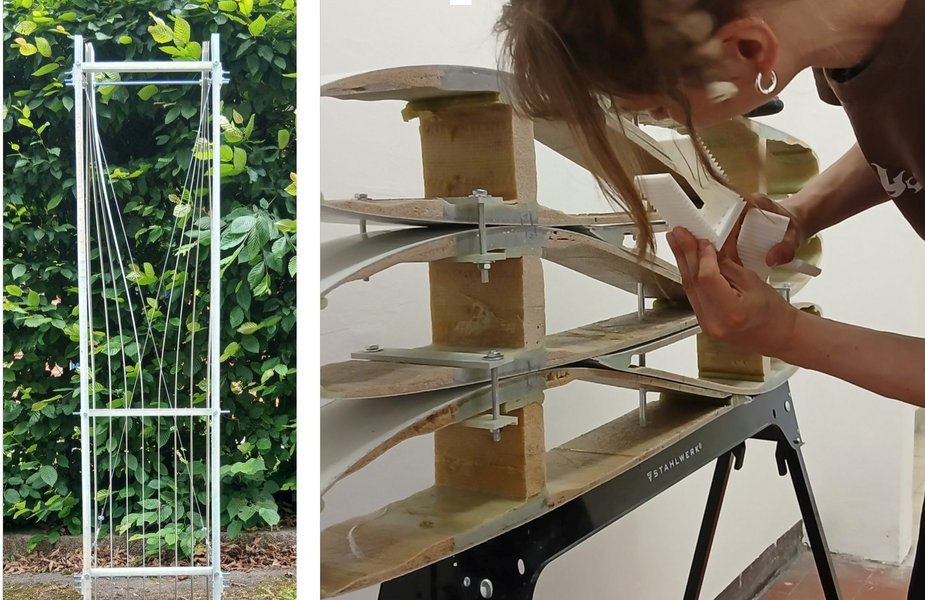
The architecture students Niklas Hengelhaupt, Theo Jörgensen, Paul Baierl, Hannah Sack, Julia Färbinger, Lena Focken, Jule Ottenberg, Lukas Höft, Leon Heimer, Emily Seemann, Clara Merrem and Christine Urbanowicz, Manuel Lippert, Henrike Bartsch, Lilly Zeißig, Deyaa Moussa, Lorenz Rehbein, Nicolai Jäkle, Annika Malin Kiehn and Alexander Romanjuta worked in pairs to develop building systems as 1:1 models based on a section of an E40-6 wing.
Rotor Blade Resource – Challenges in Machining
Old rotor blades represent a valuable resource due to their high weather resistance and long service life. Their individual sections possess different structural properties and thus offer a wide range of possibilities for reuse in the construction industry. At the same time, the permanently bonded material structure makes it difficult to separate the individual components by type, which makes the direct reuse of entire components particularly attractive.
During the design and fabrication phases, the students therefore faced the following challenges: How do the components, which vary in shape and dimensions, relate to one another? How can variations and inaccuracies be managed? Which connection points are best suited to providing the necessary structural stability and bracing? What exactly do the connecting elements at the points of contact look like? Is it possible to implement a corner solution with this concept? To this end, the students used various machining tools, sought out time- and cost-efficient machining techniques, tested screw and plug-in connections, and utilised rotor material, standard screws and bolts, as well as clamps they had developed themselves and produced using 3D printing.
Prototypes made from rotor blades impress with their performance and versatility
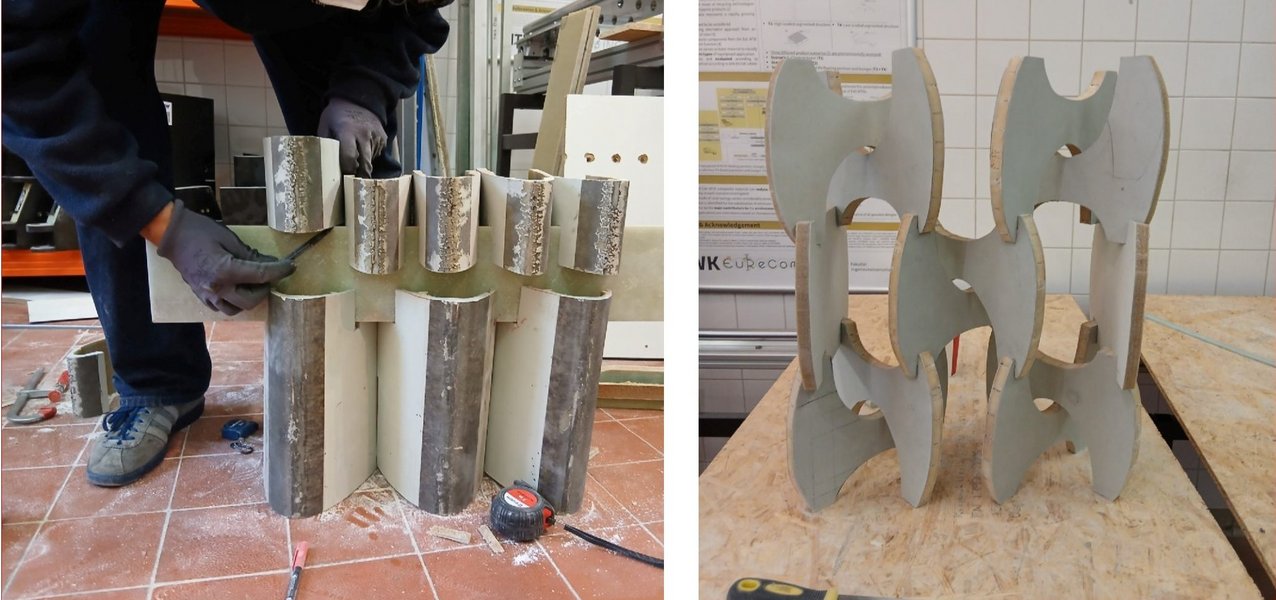
The result is ten prototypes ranging from curtain walls and shading systems to self-supporting greening systems, including plug-in systems, louvre structures, tension structures and movable façade elements. “The prototypes are impressive due to the versatility of components made from rotor blades, which are used as large-area cross-sections, panels, slats and strips. The results inspire, encourage and dispel prejudices and ignorance regarding this high-performance material – not only in terms of its performance after initial use, but also its potential for repurposing. Prejudices that have so far hindered its use in architecture, industrial construction and landscaping – in other words, in sectors with high material consumption that has hitherto been met by virgin materials,” says CCL employee Dr Pamela Voigt.
Exhibition: ‘ReRotor’ presentation:
- Opening on 22 July 2026 at 7 pm (event ends at 11 pm).
- Exhibition on 23 July 2026 from 10 am to 4 pm.
- At the Lipsius-Bau (4th floor) at Karl-Liebknecht-Straße 145, 04277 Leipzig.
Admission is free.
The models will also be on display atthe Leipzig Façade Day on 15 September 2026 at HTWK Leipzig.
