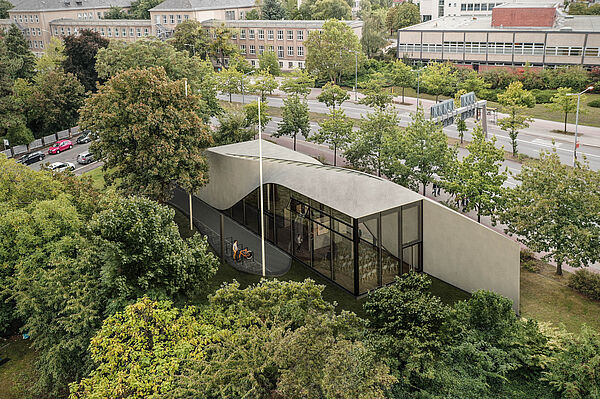
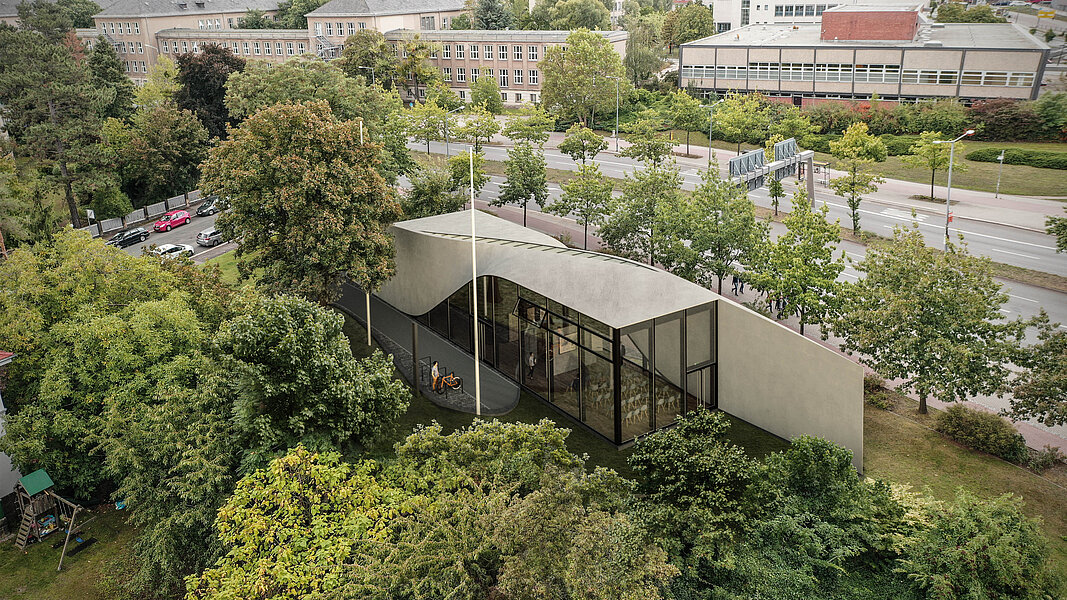
Scientists at HTWK Leipzig have been researching the innovative building material carbon concrete for many years. In contrast to the most widely used building material in the world to date, reinforced concrete, carbon concrete saves resources, materials, energy and CO₂ and therefore has the potential to revolutionise the construction industry.
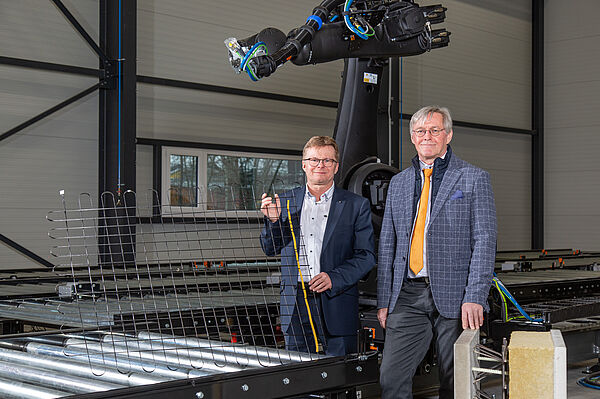
Because the modern composite material enables more sustainable and climate-friendly construction, carbon concrete is considered the building material of the future. In order to bring this material into application, the HTWK Leipzig has established the Carbon Concrete Technology Centre Germany a unique model factory in Leipzig-Engelsdorf for carbon concrete research. Automated production processes for carbon concrete components are developed here and the multifunctionality of components made of carbon concrete, for example with integrated electronics, is researched.
What is carbon reinforced concrete?
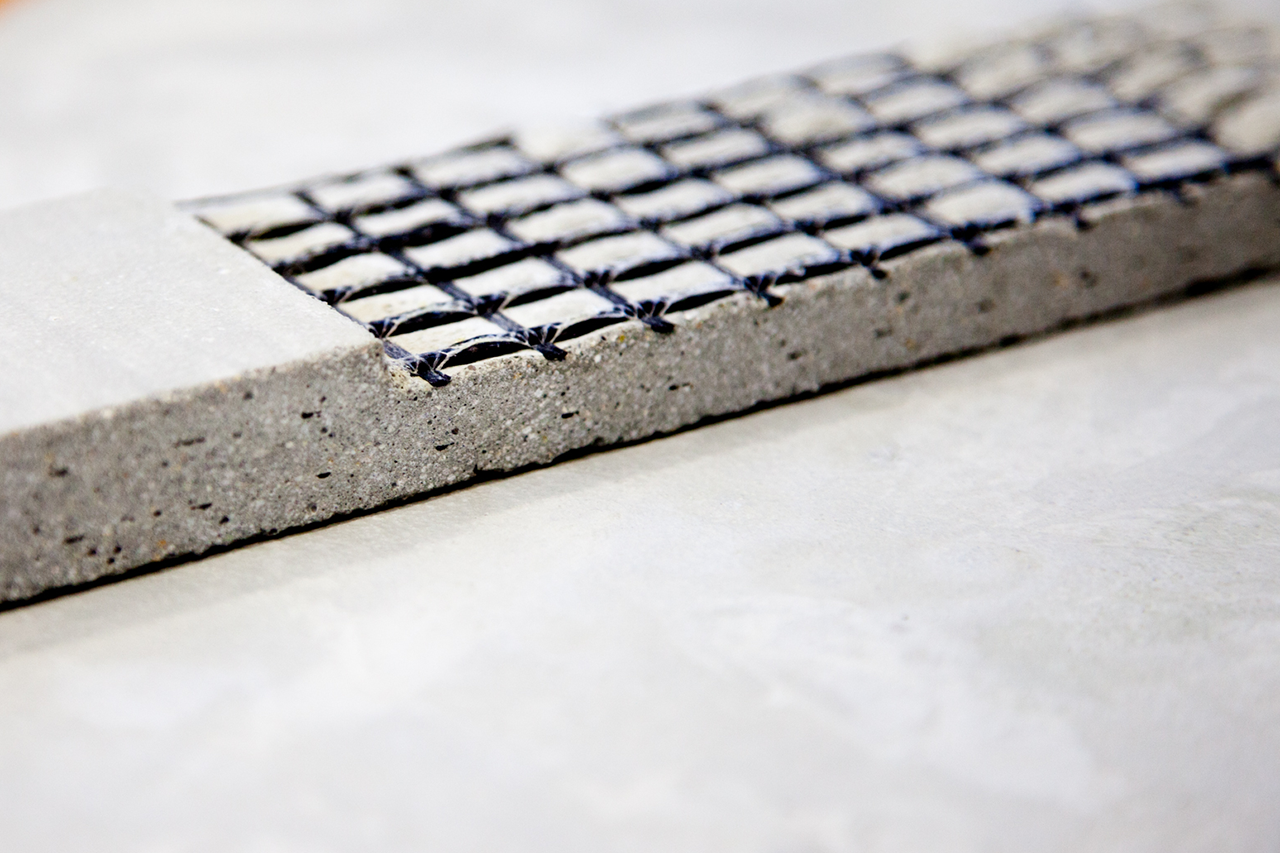
Carbon concrete is a composite material made of concrete and a reinforcement made of carbon (carbon fibres). Up to fifty thousand fine carbon fibres are combined into a yarn and processed into a fabric in a textile machine. The scrim is then covered with a coating. The reinforcement is particularly strong, cannot rust and requires significantly fewer raw materials to produce than reinforced concrete.
Advantages of carbon concrete
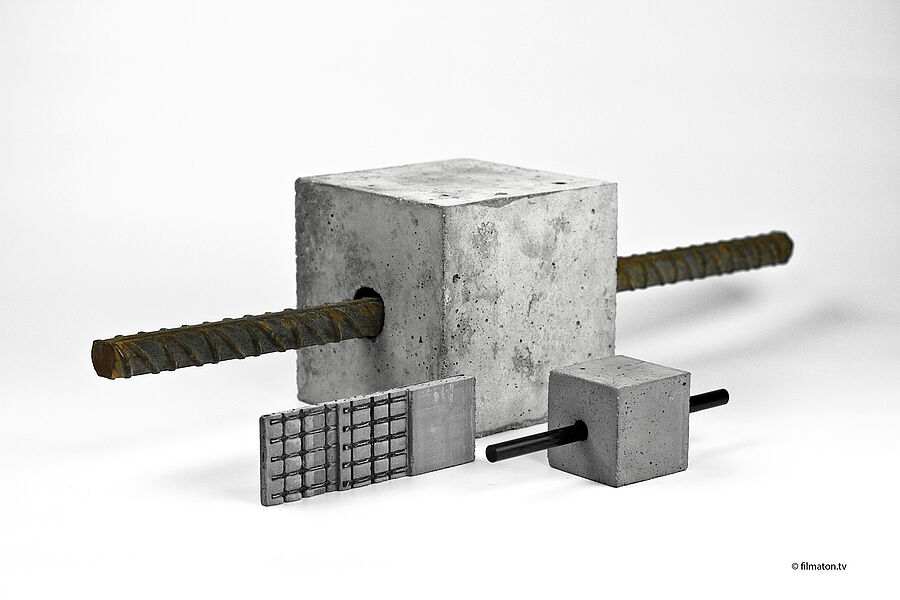
Carbon concrete is regarded as the sustainable and innovative building material of the future. It is at least as strong and stable as reinforced concrete, but more expensive to produce. On the other hand:
- Carbon concrete consumes fewer resources in production and is therefore cheaper in the long term. In addition, the energy requirement and CO₂ emissions are significantly lower (up to 50 per cent less).
- Reinforcements made of carbon concrete do not rust and are therefore resistant to corrosion. The protective layer can therefore be thinner (up to 80 per cent less material consumption).
- Carbon reinforced concrete can be recycled.
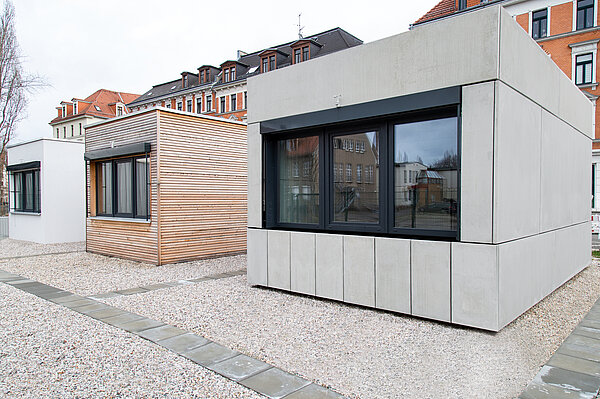
- Because components made of carbon reinforced concrete are significantly slimmer and lighter, there are more design options.
In comparison: reinforced concrete
Reinforced concrete is currently the most widely used building material in the world. It can bear heavy loads, does not burn, is extremely pressure-resistant when hardened and is cheap to produce. But:
- Concrete causes a large proportion of global CO₂ emissions and consumes large quantities of raw materials. This is because concrete is mainly made from cement, gravel, sand and water.
- Cement production alone accounts for around eight per cent of global CO₂ emissions.
- In reinforced concrete, a thick layer of concrete protects the steel reinforcement from corrosion because it can rust easily.

RUBIN-ISC
Industry standard carbon concrete through multifunctional sample components
(Duration: 01.01.2022 - 31.12.2024)

WallConnEct
Resource-efficient prefabricated components with integrated electronics thanks to ASi
(Duration: 01.10.2021 - 31.03.2024)
iClimaBuilt
Climate-adapted building envelopes through advanced insulation materials
(Duration: 01.03.2021 - 28.02.2025)

EMEK 3D
Electrically conductive 3D printing for contacting carbon fibres
(Duration: 01.02.2021 - 31.01.2023)

Digital concrete
Carbon rovings as integrated data, energy and sensor structures
(Duration: 01.02.2020 - 30.04.2022)
Carbon concrete technology centre

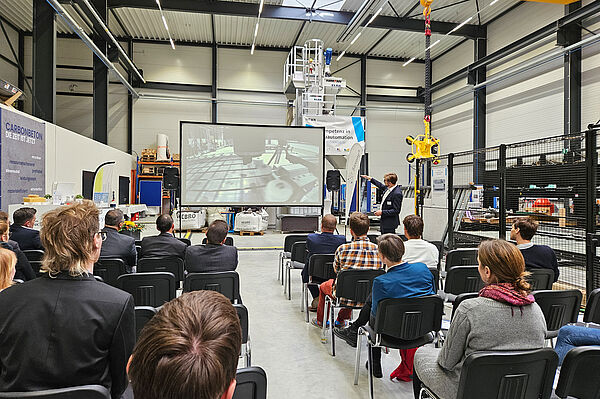
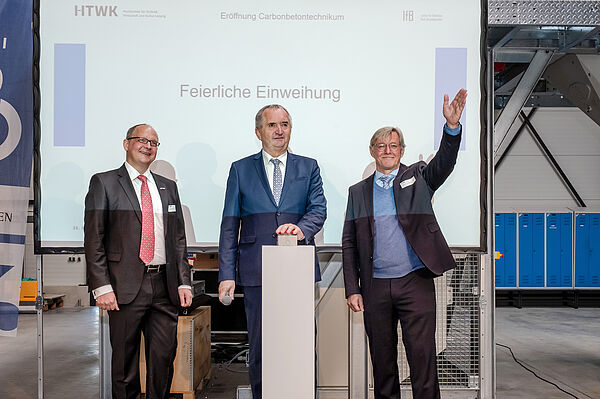
In the test hall in Leipzig-Engelsdorf, which is due to open at the end of September 2022, the Institute of Concrete Construction at HTWK Leipzig is conducting research into the automated production of components made of carbon concrete, thereby making an important contribution to the practical introduction of this modern composite material.
The establishment of the Carbon Concrete Technology Centre Germany was funded by the Federal Ministry of Education and Research (BMBF). With their generous support, the Gesellschaft für Materialforschung und Prüfungsanstalt für das Bauwesen Leipzig mbH (MFPA Leipzig) and the Staatsbetrieb Sächsisches Immobilien- und Baumanagement (SIB) ensure the creation of optimal conditions for carbon concrete research in Leipzig.