Network APPLIED AI
The Network Applied AI of the HTWK Leipzig
- comprises professorships from all faculties of HTWK Leipzig with teaching, research and transfer activities in the field of artificial intelligence (AI) and data science as well as their applications
- serves to coordinate activities and the exchange of information between the participating professorships and thus strengthens expertise in the field of applied AI, its foundations and applications
- communicates the existing competences in the field of applied AI internally and externally
- supports joint applications for research and development projects
- arranges and promotes research and transfer activities with external partners
Information and recommendations on the use of AI tools in teaching, self-learning opportunities, tools, examples and contacts at HTWK Leipzig are listed on a page of the Institute for Digital Teaching and Learning.
Content navigation
Contact us
- Section:
- FING
- Phone:
- +49 341 3076-1125
Expertise clusters and areas of application
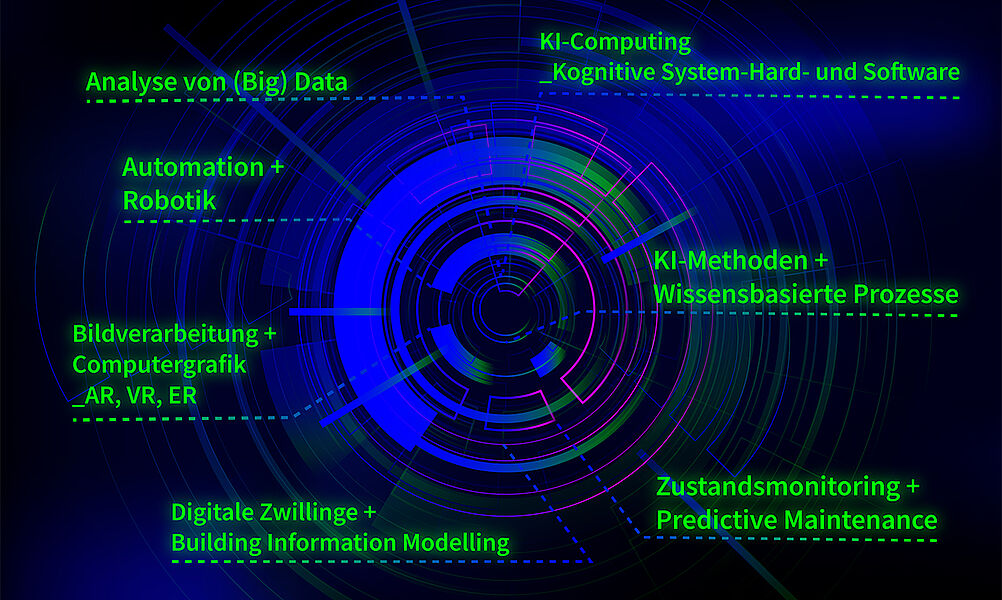
Analysing (Big) Data
Members: Prof Mario Hlawitschka, Prof Armin Lenzen, Prof Lutz Maicher, Prof Andreas Pretschner, Prof Andreas Thor
Automation + Robotics
Members: Prof Jens Jäkel, Prof Andreas Pretschner, Prof Jens Schneider, Prof Alexander Stahr
Image Processing + Computer Graphics_AR, VR, ER
Members: Prof Mirco Fuchs, Prof Mario Hlawitschka
Digital Twins + Building Information Modelling
Members: Prof André Ihde, Prof Jens Jäkel, Prof Patrick Kürschner, Prof Jochen Merker
AI Computing _Cognitive System Hardware and Software
Members: Prof Gerold Bausch, Prof Axel Klarmann, Prof Armin Lenzen, Prof Andreas Pretschner
AI Methods + Knowledge-based Processes
Members: Prof Andreas Both, Prof Patrick Kürschner, Prof Lutz Maicher, Prof Jochen Merker, Prof Hendrik Richter, Prof Sibylle Schwarz, Prof Alexander Stahr
Condition Monitoring + Predictive Maintenance
Members: Prof Faouzi Derbel, Dr Daniel Ehlig, Prof Jens Jäkel, Prof Axel Klarmann, Prof Armin Lenzen, Prof Lutz Nietner, Dr René Sallier, Prof Mathias Rudolph
Expertise:
- Camera-based data acquisition and automatic analyses in sports science applications
- Camera-based recording of vital parameters and health data
- Automatic camera-based recording of parameters in work processes
- Determination of vital parameters based on physiological signals using machine learning methods
Expertise:
- Classical optimisation algorithms
- Machine learning and image processing
- Mobile robotics - use in logistics and production
- Sensor technology and data analysis in production and logistics
- Technical process modelling
- Process development, modelling and automation
- Machine learning for medical image processing
Expertise:
- Data processing | e.g. signal processing, image processing
- Recognition of features | including pattern recognition in image data, in abstract data, object detection
- Display of data with interfaces to computer graphics
- VR (Virtual Reality)
- ER/XR (Extended Reality)
- Interactive techniques and user interface design
Expertise:
- Digitalisation of business processes, focus: knowledge-based processes
- Data-centric optimisation of business processes
- Process mining
- Productivity in digitalised collaboration
- Data-centred value creation
- Current focus project: samarbeid - cloud-based open source tool for process-oriented collaboration between teams with a strong desire for digitalisation and little or no IT knowledge of their own
Competences:
- Digital twins: parameter estimation and sensitivities
- Coupling of systems via ports, in particular of data and equation models
- Model reduction, spectral methods
- Machine learning: Numerical analysis of AI algorithms
- Explainable Artificial Intelligence, particularly Double Descent Phenomenon
- Information Geometry, Entropy
- E-learning: AI for e-assessments with feedback
Application-related further development, customisation and application of AI methods:
- with autonomous and intelligent sensor systems for edge computing in the context of Maintenance 4.0
- Machine learning (e.g. fuzzy algorithms) and deep learning
- Condition monitoring, especially in the fields of mechanical engineering, energy and environmental technology