
Radio wave innovation platform
The Radio Wave Innovation Platform at HTWK Leipzig represents an integrative approach to the transfer of results from research and development to society and the regional and national economy. The components represent different levels of vertical and horizontal transfer of knowledge and technologies. Vertical transfer takes place along value chains and includes aspects of basic research, applied research and the actual transfer into practice. While universities of applied sciences with their close links between high-quality teaching and research as well as research institutions play a key role in the first phases, the role of companies, craft businesses and start-ups increases significantly along the vertical transfer. Horizontal transfer is an expression of the necessary interdisciplinary approach that is essential to solving current problems. HTWK Leipzig works closely with numerous partners with different competences in the natural sciences, engineering and social sciences. This is reflected in a large number of successfully completed and ongoing co-operation projects.
The radio wave innovation platform is linked to a high-quality research infrastructure that has been built up in recent years and is available for joint research and development projects with partners. The infrastructure includes laboratory and technical centre capacities equipped with high-quality measurement, analysis and experimental technology.
Another key aspect of the radio wave innovation platform is the "transfer of knowledge", i.e. strengthening the human resources base for companies and society as one of the fundamental tasks of a university of applied sciences. Instruments include qualification measures for external and internal partners, cooperative Bachelor's, Master's and doctoral theses as well as staff exchanges with companies, which is essential for the economy in view of the shortage of skilled labour in many areas.
Radio wave technology as an innovative core and unique selling point
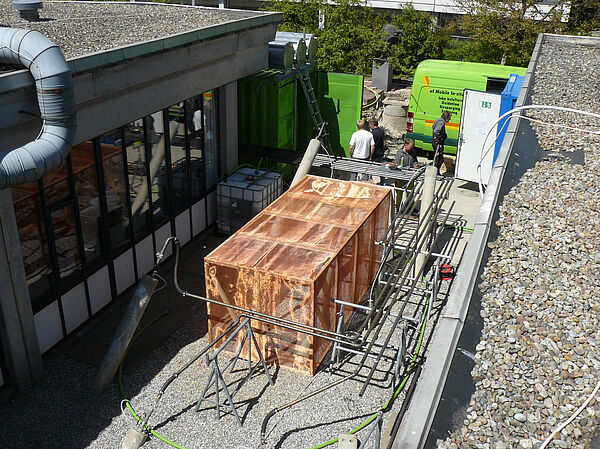
Innovative radio wave technology, i.e. direct heating through the use of electromagnetic waves in the high-frequency range, has been developed in recent years by the Helmholtz Centre for Environmental Research - UFZ and HTWK Leipzig in order to make numerous processes in energy and environmental technology as well as in the construction industry more efficient and sustainable. Examples include thermally assisted soil remediation, the drying and decontamination of masonry, the purification of contaminated exhaust air streams and the drying of natural gas or hydrogen. Thermal, chemical-free wood preservation to avoid the use of biocides and the elimination of organochlorine biocides from different materials using various physical and chemical processes are of particular importance in the context of the Saxony⁵ joint project.
RWTec innovation network
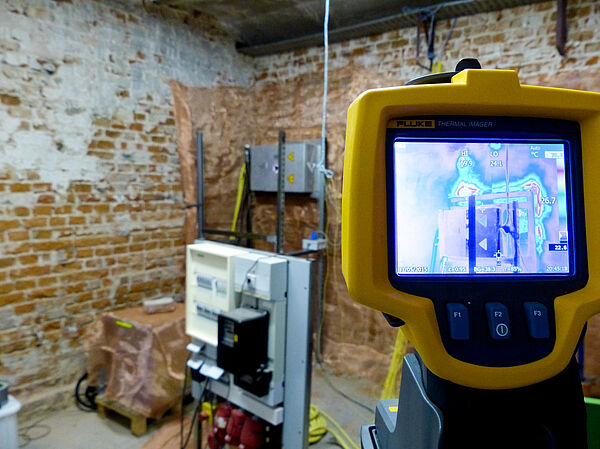
The RWTec innovation network, which is based at the HTWK Leipzig Research and Transfer Centre, was founded by around 15 research institutions and companies to further research innovative radio wave technology, develop processes and products on this basis and put them into practice. The RWTec network, which was originally funded by the BMWi, is being financed by the partners now that the ZIM funding has expired and primarily coordinates the partners' research and development projects as well as the development of new ideas for the established areas of construction, energy and the environment as well as the new topics of urban development, the hydrogen economy and the substitution of critical chemicals.
Cooperation project RWTec-Detox as an example of interdisciplinary collaboration and integration in RWTec and Saxony⁵
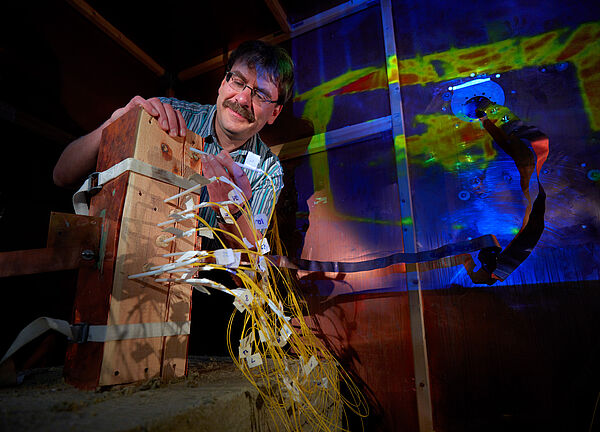
As part of the RWTec-Detox project, research and company partners are developing processes to remove biocides from various materials, particularly art and cultural artefacts. Based on radio wave technology, the thermal treatment of wooden beams is being trialled in order to remove the pollutants desorptively. This process is combined with suitable adsorbents to prevent the contaminants from escaping into the room air. Extraction processes are also being investigated to remove the active ingredients of wood preservatives (biocides) from objects. Finally, reductive-catalytic methods are being researched to convert organochlorine compounds into harmless products. All process modules can also be combined in order to enable adequate treatment of problematic cases in practice. This project is characterised by its interdisciplinary approach, which has brought together partners from very different areas on the basis of the networks.
Laboratory infrastructure
In recent years, a laboratory infrastructure has been established at the Eilenburger Straße Research Centre (FZE) that enables numerous research projects to be carried out in the context of the RWTec and Saxony⁵ networks. This addresses the areas of chemical process engineering, chemical analysis, construction, sensor technology and electronics development. Examples include a sensor measuring station for the development of selective hydrogen sensors, workstations for sample preparation, analytical equipment such as a gas chromatograph with mass spectrometer (GC-MS), a mobile X-ray fluorescence spectrometer (XRF), a Fourier transform infrared spectrometer with ATR module and a laboratory for electronics development.
Technical centre infrastructure
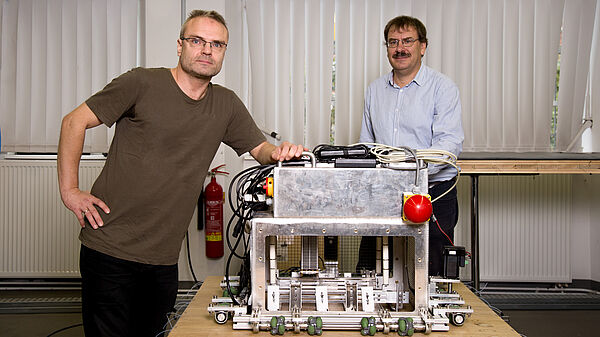
The pilot plants make it possible to transfer developments from the laboratory phase to a larger scale in order to prepare for their establishment in practice. Investigations on a pilot plant scale are characterised by particularly close cooperation with partners in the field.
The applications currently being tested with prototypes in the pilot plant relate, for example, to chemical-free wood preservation, the heating of recycled asphalt or the heating of prefabricated asphalt slabs for pothole repair.
Support for spin-off initiatives
HTWK Leipzig uses numerous instruments (Startbahn 13 start-up initiative, Saxony⁵ activities) to support young researchers in establishing their own commercial exploitation structures and preparing and implementing a company foundation. A striking example of this in the context of radio wave technology is the young company RWInnoTecGmbH, which was founded by founders from UFZ and HTWK Leipzig in March 2021.
Steady development of the innovation platform
Building on the solid scientific and engineering foundation, the established cooperative relationships, the infrastructure and the experience gained, the infrastructure platform is to be developed into a sustainable structure in the future as part of the Saxony⁵ project and supported by other partners and initiatives, which will particularly promote technology transfer via minds and joint projects.
