Project management

- Section:
- FING
- Phone:
- +49 341 3076-1178
Carbon-neutral precast concrete elements
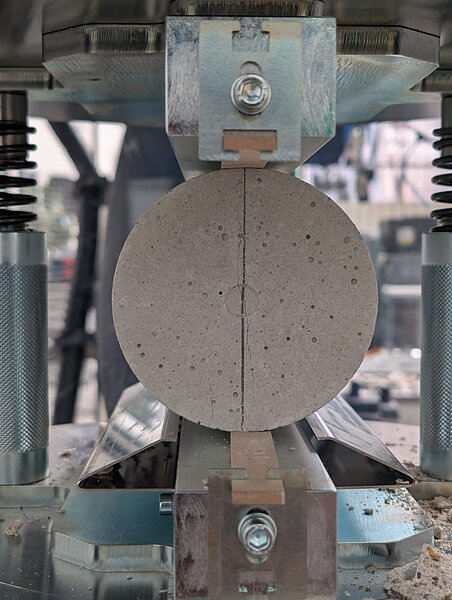
The PRECAST ZERO project is pursuing an innovative research approach that goes beyond CO₂-neutral concrete. The project aims to develop a concrete material capable of permanently sequestering CO₂, thereby serving as a store for emissions. Given the widespread use of concrete, this technology offers significant potential for scaling up. The aim is to lay the groundwork for a concrete-based CO₂ storage technology. Implementation requires an interdisciplinary consortium: planning and design (Kahnt & Tietze GmbH), binder development (Oliment GmbH), processing (Betonwerk Oschatz GmbH) and scientific investigation and automation (FTZ Leipzig). Together, the partners are addressing the following questions:
- How do composition and matrix influence CO₂ storage and mechanical properties?
- How can components made from CO₂-binding concrete be manufactured automatically?
- What are the environmental impacts of large-scale application?
- What additional functions can CO₂-storing components perform?
To answer these questions, the PRECAST ZERO project is developing a completely cement-free concrete mix based on carbonatable aggregates, such as olivine, and testing it on an industrial scale. During the project, formulations with high CO₂ storage capacity will first be developed and their mechanical properties tested. This will be followed by the transfer to the serial production of precast components, in particular wall and floor elements for multi-storey and commercial building construction. A key focus is on adapting and integrating the new mix into the existing processes of a precast concrete plant. In addition, innovative, non-metallic reinforcements will be used to reduce concrete cover and weight, prevent corrosion and increase durability. In this way, the project combines material development with practical implementation in industrial production processes.
The successful implementation of PRECAST ZERO opens up a wide range of economic and application-related prospects. The core objective is a CO₂-storing concrete building system suitable for series production, which is integrated into existing production processes and used for wall and floor elements in residential and commercial construction. Initial pilot applications are taking place in projects run by the partners in Saxony. This addresses a market that produces around 50 million m² of precast concrete elements annually in Germany and is increasingly demanding mass-produced, resource-efficient construction methods. A market share of 2–3% is expected for CO₂-storing components in the medium term, corresponding to a turnover of EUR 120–180 million per year. From the market launch onwards, the partners plan an annual production of 20,000–30,000 m² with significant revenue growth. In addition to environmental benefits such as an improved carbon footprint, the new products also offer economic added value through shorter construction times, reduced material quantities and compliance with ESG and taxonomy criteria.
About the Institute for Process Automation and Embedded Systems
Project team
- Section:
- FING
- Phone:
- +49 341 3076-1178

Funding