Projektleitung

- Section:
- FTZ
- Phone:
- +49 341 3076-6278
What impact do green roofs have on urban infrastructure?
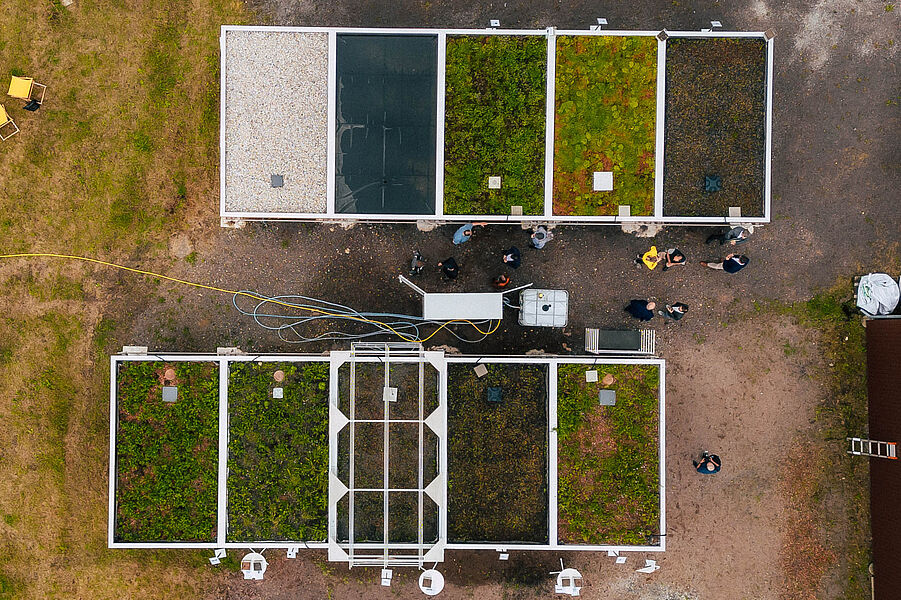
As the proportion of water bodies and green spaces continues to decline, unfavourable humidity conditions develop, resulting in heat islands and poor air quality in cities. One way to counteract these phenomena is the increased use of green roofs. However, in the wake of climate change, weather events such as heavy rainfall and dry spells are becoming increasingly frequent, which have varying effects on green roofs in urban areas and, in particular, on their effectiveness in retaining rainfall. Prolonged dry spells lead to the complete drying out of the green roof substrate and alter its re-wetting behaviour during subsequent heavy rainfall or repeated precipitation events of varying intensity and duration.
Against this background, the resilience of various green roof systems is to be investigated. As part of the project, ten green roofs with different system configurations will be examined under varying rainfall loads. The aim is to draw concrete conclusions regarding the protective effect and the retention capacity of the systems. Furthermore, specific properties of the substrates used, such as storage capacity, pore volume, etc., will be examined in greater detail to establish a comprehensive water and energy balance for different types of green roofs. On this basis, urban water management simulation models can better represent the effect of different green roof structures on the runoff situation.
The planned project will also aim to determine the potential savings in the design of newly planned sewerage systems. Due to the water retention capacity of green roofs, it is possible to reduce sewer dimensions and thus implement narrower buffer strips during development or pipe modifications. In parallel, there are plans to establish a Saxon ‘green roof’ network and to develop a practical guide on the use of green roofs for local authorities, municipalities and planning offices. Guided tours and consultations at the pilot plant will be offered to experts and interested members of the public. At the end of the project, a ‘green roof’ workshop will be held for representatives from local government, authorities, planning and engineering firms, during which the project results will be presented and discussed. The results are intended to contribute to the optimal use of green roofs as ‘tools’ for managing extreme rainfall events in urban areas, in combination with other suitable technologies.
HTWK Leipzig is focusing in particular on analysing the effects of green roofs’ retention capacity on sewer hydraulics during various rainfall events. The aim of the sub-project is to assess green roofs using time series from the German Weather Service for any given year or location in Germany, to utilise the data for runoff simulation of green roofs for use in sewer network simulation programmes, and to define standard parameters for the use of different green roof variants for implementation in the sewer network calculation programme.
Project team

Partners
- Decentralised Infrastructure Education and Demonstration Centre – BDZ e.V. (lead organisation)
- Leipzig Municipal Waterworks Ltd
- Dresden Municipal Drainage Ltd
- Leipzig University of Applied Sciences
- Helmholtz Centre for Environmental Research – UFZ
Funding