Project management

- Section:
- FB
- Phone:
- +49 341 3076-6950
The aim is to provide the first comprehensive and systematic information on the mechanism of action of the RDC process
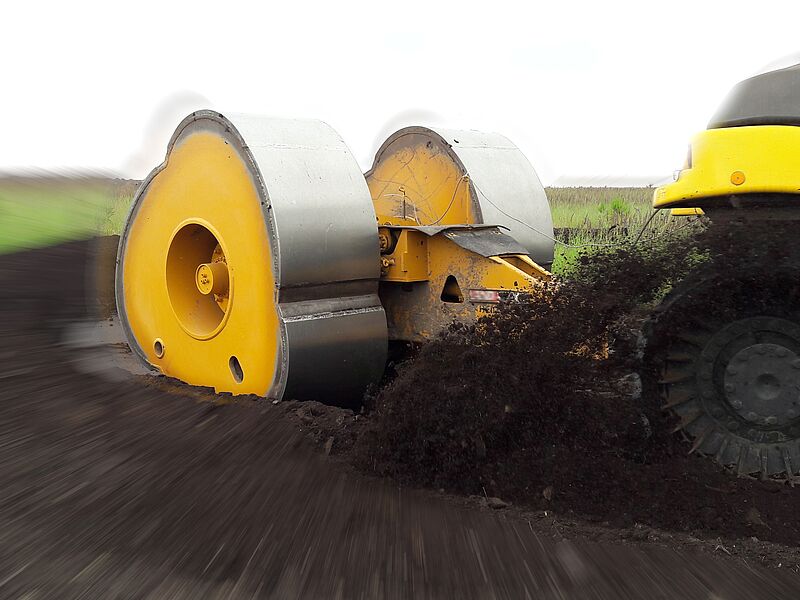
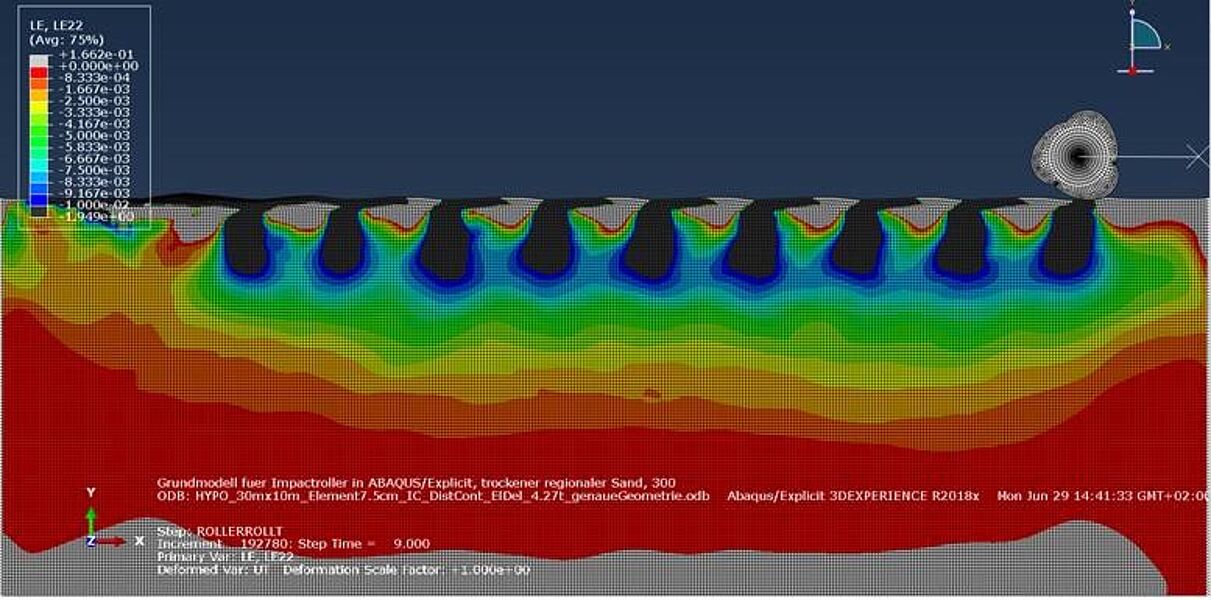
Dump sites are post-mining landscapes created by the dumping of overburden, the material left after coal extraction. This material presents a dangerous combination of particularly low bulk density and high water content. If these areas are to be made accessible to the public, they must be reclaimed. The technical implementation is carried out through what is known as soil compaction. Conventional methods of soil compaction are either too dangerous or too uneconomical here. A process is required that combines high travel speed with high compaction performance. Rolling Dynamic Compaction (RDC) In this technique, an oval-shaped roller is dragged across the terrain. Due to its irregular geometry, the roller tilts and compacts the soil very strongly upon impact, enabling higher travel speeds and greater working depths than with conventional roller trains. However, no systematic scientific studies on the use of RDC on spoil heaps are currently available.
The RoDyCom project aims to analyse the mode of action of RDC in detail and investigate its application for large-scale compaction of open-cast mine spoil heaps. The project team primarily seeks to determine how the kinematics of the entire compaction system are interrelated. This has not yet been described. To this end, a suitable application is being developed to better evaluate arbitrary geometries at different travel speeds than has been possible to date. It will then be easier to estimate the depth of action. The planned field and laboratory tests will be carried out using, amongst other things, dry sand and on actual Lusatian spoil heap soil. The results will be summarised in a set of guidelines for the application of the RDC system and for evaluating the success of compaction.
The project team combines geotechnical engineering, measurement technology and mechanical engineering into an interdisciplinary project that will, for the first time, provide comprehensive and systematic information on the mechanism of action of the RDC. Consequently, soil compaction can be carried out more effectively, precisely and safely, for example during the restoration of post-mining landscapes. The results are highly relevant for the large opencast mining areas in Germany, such as in Lusatia and the Central German Mining Region, but can also be utilised internationally.
Funding