
Project management

- Section:
- FING
- Phone:
- +49 341 3076-1125
Exoskeleton as a mobility aid for climbing stairs
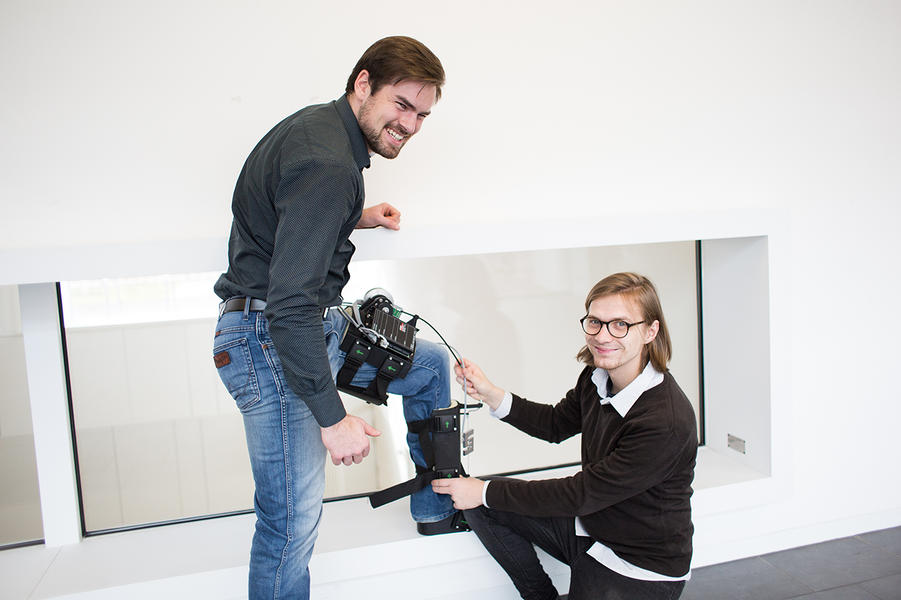
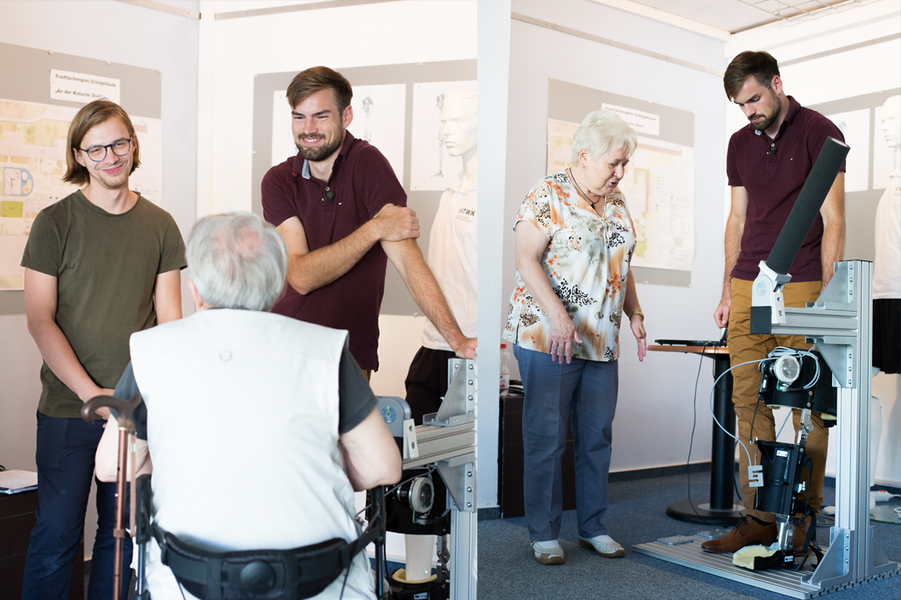
Germany’s demographic trends are creating a particular need for age-appropriate design of the home environment through technical solutions. The safe, intelligent mobility assistance system (siBUS) has been developed for this purpose as part of current and previous R&D projects. It helps older people to negotiate stairs in their own homes. As part of the SAB validation funding, it is now to be validated and prepared for market transfer.
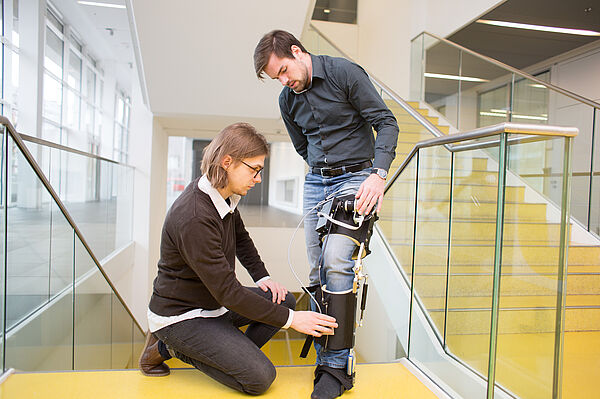
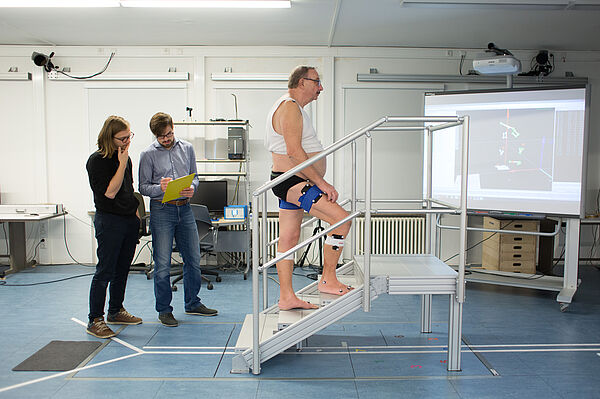
The siBUS was developed in previous R&D projects. It is an exoskeleton that makes it easier for older people to negotiate stairs in their home environment. The operating principle essentially involves the knee joints – where the greatest lack of strength usually occurs – being supported in their movement by a special drive technology. With the aid of sensors and intelligent control, the actuators provide the individually required additional force in any situation. The necessary level of support was determined in extensive biomechanical studies using a specially developed method. The task of an integrated, AI-based control system is to learn and predict the individual support requirements. It also learns to recognise the user’s desired movement based on differential values. The AI control system of the siBUS is based on force control methods typical of exoskeletons. Furthermore, the feasibility of providing support with the siBUS has been tested in various simulations. To investigate how it works, a test bench for the siBUS was also developed in previous projects.
The validation of the siBUS is based on four aspects: biomechanical validation, measures to increase user acceptance, validation of the technological implementation, and validation of the commercialisation strategy.
Biomechanical validation is intended to demonstrate the biomechanical effectiveness of the overall system as a human-machine system. Successful commercial implementation requires user acceptance, which is to be ensured through targeted measures. These include functional demonstrations of the siBUS demonstrator and the conduct of methodological surveys with experts from the target group who have already been selected. The target group is thus integrated into the development and transfer process, and siBUS is further developed on the basis of their requirements. The aim of the validation of the technological implementation is to provide insights into the cost-effective manufacture of the individual components. The validation of the commercialisation strategy aims to plan, compile and, in some cases, already implement specific technology transfer measures. The focus is on the commercialisation strategy, risks and market analyses.

Project team
- Section:
- FING
- Phone:
- +49 341 3076-1125

- Section:
- FING
- Phone:
- +49 341 3076-4115

