Project management

- Section:
- FB
- Phone:
- +49 341 3076-6950
Sensors are intended to make dynamic soil compaction, such as drop-weight compaction, more resource- and cost-efficient
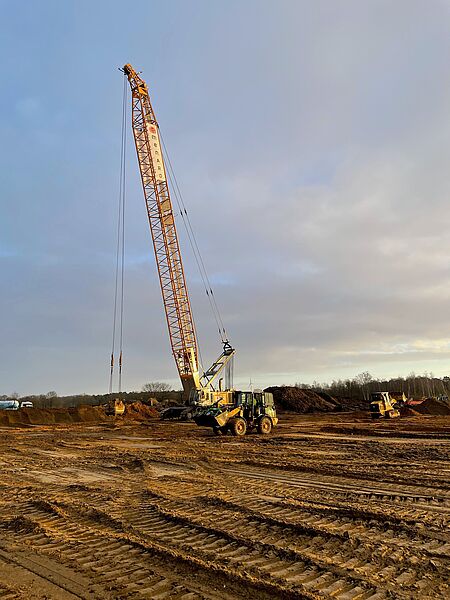

Improving the subsoil over very large areas is often a key component of major housing and infrastructure projects. Dynamic soil compaction, specifically drop-weight compaction (DWC), is an established method for this purpose. In large-scale international projects covering many millions of square metres, tens of thousands of individual points regularly need to be compacted. However, there is currently no way to assess the progress of compaction across the entire area in real time whilst construction is underway for DWC. The state of the art involves spot checks after compaction has been completed, which makes efficient energy-based control at individual points impossible and often results in ‘too much’ or ‘too little’ compaction. The primary aim of the project is therefore to develop a method for the integrated monitoring of compaction success in FGV. If this research project succeeds, even the smallest changes can have a huge leverage effect in terms of time, money and quality, given the enormous compaction volumes – FGV will then become a resource- and cost-efficient technology with a high level of process reliability.
The development is based on the integration of optical information from digital surface models and sensor-recorded measurement data.
The proposed solution combines laser scans of the ground surface with acceleration measurements from the falling weight. From a research perspective, it is necessary to clarify how the geometric and geotechnical properties in the compaction zone change during the compaction process as a function of the relevant influencing factors relating to soil and process technology. To this end, scaled 1g model tests are being carried out, in which changes in geotechnical parameters are compared with the sensor-based and optical measurement data. The verification methodology developed on the basis of model phenomenology is validated using numerical modelling (finite element method with a coupled Euler-Lagrange approach) as well as in large-scale tests. The aim is to enable an assessment of changes in geotechnical parameters and their spatial extent from the measurement data by assigning functional dependencies.
Funding