Project management

- Section:
- FB
- Phone:
- +49 341 3076-6267
Development of extruded lightweight concrete elements made from recycled crushed sand
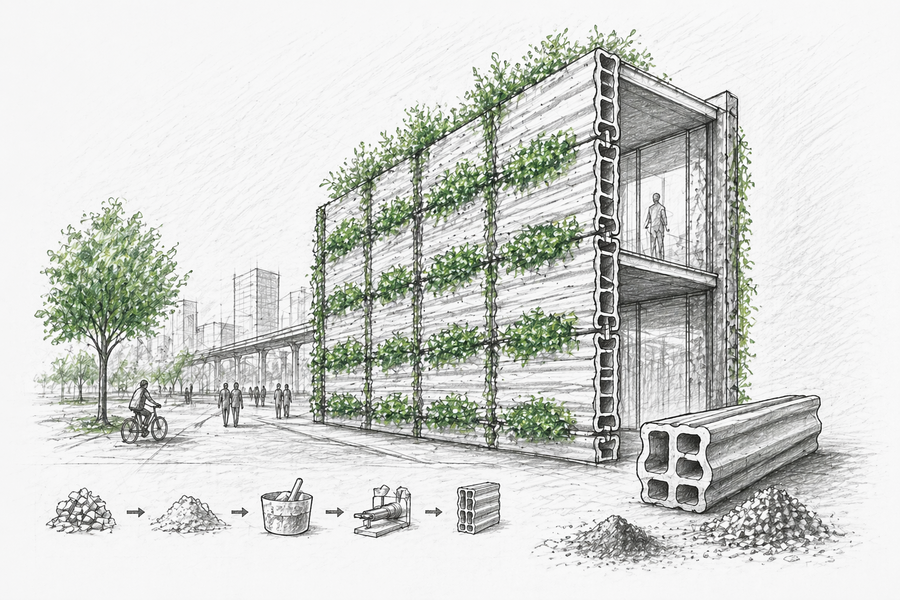
The LEBENSADER research project addresses a key problem in the construction industry: large quantities of fine-grained concrete waste (crushed sand < 2 mm) have so far remained unused or have only been put to low-value use. The aim of the project is to convert these secondary raw materials into high-quality, lightweight concrete components using a novel extrusion process. This involves the development of innovative geopolymer and fine-grained concretes that enable resource-efficient and potentially low-carbon production. The resulting building elements can be used in particular in building renovation and new construction, for example as façade, wall or ceiling elements. By closing material cycles, the project makes an important contribution to the circular economy, the reduction of primary raw materials and climate-resilient urban development.
An end-to-end process chain is being developed for the production of extruded concrete components from recycled crushed sand. This encompasses the processing of fine fractions, the development of extrudable geopolymer and cement-reduced concretes, and shaping via extrusion processes on a laboratory and pilot plant scale. This will be followed by the transition to industrial scale and the production of demonstrator components, which will be tested in a functional prototype (green façade) in a real-world environment. HTWK Leipzig contributes its expertise in hygrothermal and structural simulation, experimental component testing, and monitoring under real-world conditions. In addition, life cycle assessments are carried out and approval-relevant parameters for the use of the new building materials are developed.
The extruded lightweight elements made from recycled crushed sand offer a wide range of potential applications in building construction, particularly as façade, wall and ceiling elements, as well as for infrastructure components. Thanks to their profiling and potential hollow structures, they enable material-efficient constructions with additional functional benefits, such as for building greening or water management in line with the sponge city principle.
Partners
- Fraunhofer Institute for Ceramic Technologies and Systems
- REIKAN Mineralik GmbH
- ECT-KEMA GmbH
- Oschatz Concrete Works Ltd
Funding