
Transfer Assistant – Multi-axis yarn laying – Retaining STEM professionals 2021 to 2027
Development and transfer of a process and manufacturing technology for novel semi-finished products for carbon concrete components using multi-axial direct yarn placement technology for fully automated production into commercial practice
Duration: 1 March 2025 – 31 August 2028
Funding: Sächsische Aufbaubank - Förderbank (SAB)

Project management

- Section:
- FB
- Phone:
- +49 341 3076-6267
Transferring research into industry – Multiaxial yarn laying technology for practical application
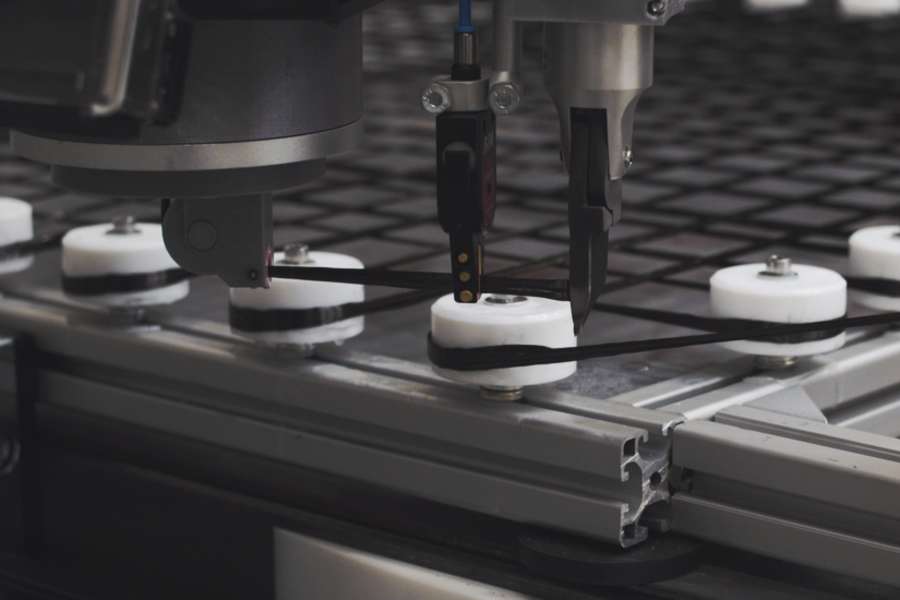
The aim of the project is to further develop and bring to industrial scale the multi-axial direct yarn placement (MDGA) technology for the production of novel, resource-efficient carbon fibre reinforcements for precast concrete elements.
The automated, load-path-oriented placement of carbon fibres is intended to result in an innovative semi-finished product that enables the reinforcement structure to be precisely adapted to the load requirements.
Problem statement and context:
Conventional reinforcement of concrete components is usually carried out using steel-based systems, which are susceptible to corrosion, heavy and material-intensive. Even existing textile-reinforced alternatives require complex manufacturing steps, which have so far limited their large-scale industrial application.
Multiaxial direct yarn placement technology offers a paradigm shift here: it enables waste-free, robot-assisted placement of carbon fibres directly onto a substrate or within the formwork – precisely, digitally controlled and resource-efficient.
Societal relevance:
The project makes a direct contribution to the transformation of the construction industry towards low-carbon circular production.
The use of corrosion-free carbon fibre reinforcement enables component thicknesses to be reduced, material consumption to be cut by up to 40%, and the service life of structures to be significantly extended. The project thus contributes to the objectives of the national climate protection and resource efficiency strategy, as well as the construction sector’s transition.
Potential applications:
The results achieved are intended to enable the precast concrete industry, design offices and construction companies to develop new applications in the field of lightweight, infrastructure and safety components. There is significant potential, particularly for thin-walled facades, floor slabs and modular bridge elements.
Background to the research questions:
The project focuses on how the process parameters of multi-axial yarn placement (fibre orientation, impregnation, tension, speed) can be optimised to produce reproducible, high-performance carbon reinforcements that can be integrated into precast concrete production lines without intermediate steps.
The project investigates the technological limitations, economic factors and regulatory requirements for the industrialisation of the technology.
Approaches:
The project adopts an integrated research and transfer approach that combines technical development with industrial application.
To this end, the technology is being scaled up step-by-step from laboratory to pilot scale. The key approaches include:
- Development of optimised process parameters (yarn tension, impregnation temperature, deposition speed) for load-path-aligned deposition,
- Integration of digital sensor technology and process monitoring for real-time control,
- Validation of the mechanical and physical properties of the produced structures through tensile, bending and shear tests,
- Numerical simulation using FEM models to map material behaviour,
- Development of a criteria catalogue for evaluating technological, economic and environmental factors,
- Bringing together research and practice through the transfer assistant as an interface between the university and industry.
Investigation methods:
The methodological basis consists of experimental test series, materials analysis (microscopy, mechanical testing), process-accompanying data acquisition (sensor technology, control engineering) and digital modelling.
By linking experimental data with simulation results, cause-and-effect relationships between process parameters and component properties are identified.
Integration of expertise at HTWK Leipzig:
The project is supported technically by HTWK Leipzig, in particular by the Research and Transfer Centre (FTZ).
The centre possesses proven expertise in the fields of carbon concrete, textile reinforcement, materials analysis and construction process engineering.
The existing infrastructure – including testing facilities, laboratory automation and metrological equipment – enables a thorough scientific investigation of the process parameters.
Transfer Assistant Dr.-Ing. Matthias Tietze is responsible for coordinating between the scientific research at HTWK and its practical implementation in industry.
Need:
The construction industry faces the urgent task of reducing material and energy consumption without compromising the safety and durability of structures.
The precast concrete sector in particular requires innovative reinforcement systems that are corrosion-free, lightweight, high-performance and suitable for automated processing.
Here, the multiaxial direct yarn laying process bridges a crucial gap between research findings and industrial implementation.
Application potential:
The processes developed in the project enable:
- the production of load-optimised carbon reinforcement with minimal waste,
- integration into existing production lines through modular, adaptive laying systems,
- a reduction in material usage and carbon footprint of up to 40%,
- new design and functional possibilities (e.g. combination with sensor technology or shielding structures),
- the series production of lightweight components, particularly for ceilings, walls and bridges.
Application and transfer:
The findings will be put directly into practice through demonstration components, technology workshops and collaborations with Saxon SMEs.
Furthermore, the results will be incorporated into the further development of existing production systems and standardisation processes.
In the long term, the technology is intended to be established as an industrial standard for carbon reinforcement, thereby making a substantial contribution to the sustainable transformation of the construction industry.
